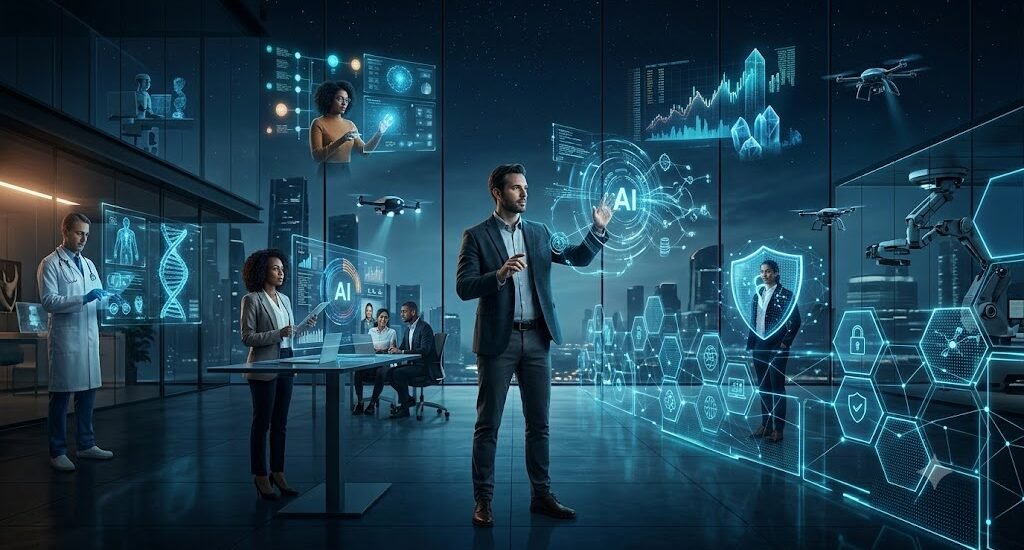
The The Future of AI is no longer a topic that concerns exclusively researchers, engineers, and major technology companies. Artificial Intelligence has already entered our everyday lives and is being used, often without us even realizing it, in information searches, entertainment, online shopping, transportation, communication, and work.
From healthcare and employment to the economy, education, technology, and privacy, Artificial Intelligence is no longer a distant science-fiction scenario. It is the technology that is already changing the way we live and work. In recent years, the development of Generative AI and increasingly advanced AI systems has accelerated this transformation. The capabilities of modern models are no longer limited to generating text or images. AI can analyze information, process different types of data, support complex tasks, and gradually become integrated into services that we use every day.
The question, therefore, is no longer whether AI will change our everyday lives.
The real question is how deeply it will change them, how quickly this will happen, and how well prepared we will be for the changes that are coming..
AI and Healthcare: Medicine Enters a New Era
One of the most important areas in which The Future of AI is expected to have a tremendous impact is healthcare.
Artificial Intelligence is already being used to analyze medical images, support diagnosis, process large volumes of medical data, and assist research into the development of new medicines. In the future, AI may contribute even more to personalized medicine, helping healthcare professionals make use of data from different sources and make more informed decisions.
The World Health Organization points out that AI can offer significant opportunities in healthcare, but at the same time, strong governance, protection of rights, and human oversight are required. In fact, in a 2025 report on the European Region, the WHO analyzed the readiness of 50 countries to integrate AI into healthcare systems, highlighting both the opportunities and the challenges related to safety, governance, and data.
This, however, raises a critical question: how much should we trust an AI when a decision concerns our health?
AI can become an extremely powerful assistant for doctors, but it should not be treated as an infallible authority. A system can make a mistake, rely on incomplete data, or produce an answer that appears completely reliable while actually being incorrect.
The challenge of the future will not only be to create smarter AI systems. It will be to create systems that we can trust, control, and understand..
AI and Work: Will AI Replace Humans?
Perhaps no other question surrounding The Future of AI generates as much intense discussion as the future of work.
The answer, however, is more complex than simply saying, "AI will take our jobs."
Artificial Intelligence is likely to automate specific tasks, change the way entire professions operate, and create new occupations that we are only beginning to understand today.
According to the Future of Jobs Report 2025 by the World Economic Forum, major technological changes are expected to lead to the creation of approximately 170 million new jobs by 2030 and the displacement of approximately 92 million, resulting in a net increase of 78 million jobs. The same report highlights that nearly 40% of the skills required in the workplace are expected to change, while demand for AI, big data, and cybersecurity skills is expected to increase significantly.
his means that the biggest change may not be the disappearance of work, but its transformation..
Professions that rely on repetitive processes, data entry, basic information processing, or standardized content production are likely to be affected more significantly. At the same time, there will be a growing need for people who can combine technical knowledge with creativity, critical thinking, communication, and problem-solving abilities.
The real challenge, therefore, is not only to learn how to use AI. It is to learn how to work alongside it..
AI and Education: The Personal Digital Teacher
Education is another area where the The Future of AI can bring enormous changes.
Imagine a student who has access to a digital assistant that knows their level, understands where they struggle, and can explain a topic to them again in a different way.
AI can adapt education to the needs of each student, create personalized exercises, assist with foreign language learning, and function as a kind of personal tutor.
This could make knowledge more accessible than ever before.
However, there is also a significant risk. If students use AI to think and work instead of doing so themselves, their ability to analyze, write, and solve problems independently may gradually decline.
The real value of AI in education does not lie in doing the student's work for them. It lies in helping them learn better..
AI and the Economy: The New Productivity
The impact of AI on the economy may be even greater than we currently realize.
A small business can now use AI tools for tasks that in the past required entire teams of people. Marketing, customer support, data analysis, content creation, and process automation can all be performed faster and more efficiently.
This creates significant opportunities.
At the same time, however, there is a risk of creating a new digital divide between businesses and individuals who have access to advanced AI tools and those who lack the knowledge or resources to use them effectively.
The same applies at the national level. Access to computing power, data, expertise, and specialized human talent could become a significant factor in economic power in the coming years.
AI can therefore significantly increase productivity. The question is who will benefit the most from this increase..
AI and Personal Data: How Much Does It Really Know About Us?
Perhaps one of the most important and least discussed aspects of the The Future of AI concerns personal data.
As AI systems become more intelligent, the data on which they are trained and operate becomes increasingly important.
The issue is not only what we choose to type into an AI chatbot. It is also what a system can infer from our behavior.
Our online searches, purchases, locations, preferences, social media interactions, and even the way we write or speak can create an extremely detailed digital profile.
AI can combine enormous amounts of data and identify patterns that a human would not easily be able to recognize.
This can be used to provide better services and greater personalization. However, it can also lead to increased surveillance, profiling, and loss of privacy.
The protection of personal data will therefore become even more important in the future. And as we have discussed in our articles about Stolen Data and The Dark Webdata has already acquired enormous value in the digital world.
AI and Cybersecurity: The Attacker and the Defender
The relationship between AI and cybersecurity is perhaps one of the most critical issues for the future.
On the one hand, AI can help security professionals detect suspicious activity, analyze enormous volumes of data, and identify threats more quickly.
On the other hand, the same technologies can be used by cybercriminals.
AI-generated phishing emails, deepfake videos, voice cloning, and automated scams can make attacks far more convincing and more difficult to detect.
We have already seen how Deepfake Scams can be used to deceive victims, while techniques such as Quishing works, use QR codes to direct users to malicious websites.
In the future, cybersecurity will not simply be a battle between humans and computers. It will be a battle between AI systems used for defense and AI systems used for attack..
For this exact reason, understanding AI will become an important part of modern digital security.
The Major Advantages of AI
The discussion surrounding the The Future of AI should not focus exclusively on the risks.
AI can make our lives easier, increase productivity, and provide access to knowledge and services that were previously difficult to obtain.
It can help a doctor analyze data, help a student understand a difficult subject, and help an employee automate repetitive tasks.
It can also help people with disabilities through advanced accessibility tools, support scientific research, and contribute to solving complex problems.
Perhaps the most important advantage is that AI can function as a multiplier of human capabilities..
The Major Risks of AI
Every technological revolution creates new opportunities but also new risks.
Job displacement, privacy violations, misinformation, deepfakes, algorithmic bias, and excessive dependence on AI systems are some of the most significant challenges.
Another risk is the concentration of enormous technological power in the hands of a limited number of companies and organizations.
However, perhaps the greatest risk is not that AI will necessarily become "evil."
It is that people will use it without understanding how it works, what its limitations are, and when it can make mistakes..
What Will Our Everyday Lives Look Like in the Future?
Imagine an ordinary day a few years from now.
You wake up and an AI assistant has already organized your schedule. Your home has automatically adjusted the temperature and energy consumption. Your car suggests the optimal route.
At work, AI agents handle repetitive processes while you focus on decision-making and creative tasks.
In healthcare, smart devices continuously monitor certain indicators and can identify changes that deserve a doctor's attention.
In education, every person may have access to a personal AI tutor.
Shopping, entertainment, and information are fully personalized.
This sounds extremely convenient.
However, it creates a new question:
How much of our lives do we really want to delegate to algorithms?
Convenience can be a tremendous advantage. However, it can also create dependency.
If we allow AI to constantly make decisions for us, there is a risk that we will gradually lose our ability to make decisions on our own.
How Should We Prepare for the Future of AI?
The best way to prepare is not to fear AI.
It is to learn how to use it.
Η AI literacy is expected to become a fundamental skill, not only for technology professionals but for society as a whole. The European Union has already incorporated the need for AI literacy into the framework of the AI Act, with relevant obligations that have already begun to take effect.
This means that people should at least understand the basic principles of how AI works, know that its outputs can be incorrect, and be able to critically evaluate the information it produces.
At the same time, protecting privacy will become even more important. We should not blindly share personal or sensitive data with just any AI tool, just as we would not give such information to a stranger online.
Finally, we need to invest in skills that are difficult to fully automate. Critical thinking, creativity, communication, collaboration, adaptability, and problem-solving will remain extremely important.
Perhaps the greatest skill of the future is not knowing everything about AI.
It is knowing when to use it, how to control it, and when not to trust it..
Artificial Intelligence is neither the ultimate savior nor the ultimate threat.
It is a tool that can be used in many different ways.
It can help medicine, transform education, increase productivity, and create new opportunities. At the same time, it can create new risks for privacy, employment, security, and the reliability of information.
The future of AI will not be determined solely by how intelligent machines become. It will also be determined by how responsibly we choose to use them.
As we discussed in our articles about Stolen Data, The Dark Web, Ethical Hacking,, τα Deepfake Scams, τα QR Code Scams and Strong Passwords,technology can be used both for protection and for attack.
The same applies to AI.
Το The Future of AI is not something that will happen at some point in the distant future. It has already begun. And the sooner we learn to understand both its capabilities and its limitations, the better prepared we will be for the digital world that lies ahead.
This article is published exclusively for informational and educational purposes. Its purpose is to inform the public about the development of Artificial Intelligence, its capabilities, risks, and impact on everyday life, work, healthcare, the economy, and digital security. The information presented does not constitute professional, medical, or financial advice.
Find more Cyber Security articles or contact us to learn more about cybersecurity awareness, digital privacy, online safety and modern cyber threats.