Incident Response Planning: Your Playbook for When Cyberattacks Happen
You’ve read about threats. You’ve implemented defenses. You’ve backed up your data. You’ve enabled multi-factor authentication. You’ve done everything right. And then a ransomware attack strikes anyway. Your systems are encrypted. Your data is locked. Hackers are demanding payment. You have hours to decide what to do. If you haven’t planned for this moment, you’ll panic. You’ll make hasty decisions. You’ll pay ransom you shouldn’t pay. You’ll damage your reputation further. Or you might recover well. If you have an incident response plan, you know exactly what to do. You execute the plan. You contain the damage. You recover properly. The difference between catastrophe and manageable incident is preparation. This guide teaches you how to create an incident response plan that protects you when attacks happen.
Why Incident Response Plans Matter
Incident response planning assumes the worst: attacks will succeed. Despite all your defenses, attackers will sometimes get in. The question isn’t whether you’ll experience a security incident. It’s whether you’ll have a plan for when it happens.
The statistics are stark. Organizations with incident response plans recover from breaches in days or weeks. Organizations without plans take months or face permanent data loss. The average incident costs $4.45 million for organizations without response plans. For organizations with response plans, costs drop to $2.5 million. The investment in planning pays for itself in a single incident.
Speed is critical. In the first hours after an attack is detected, decisions matter enormously. Do you shut down affected systems? Do you try to preserve evidence? Do you contact authorities? Do you notify customers? Do you pay ransom? Without a plan, these decisions are made under extreme stress by people with no experience. With a plan, responses are predetermined by experienced people who’ve thought through the best approach.
Communication is critical too. Who needs to know about the incident? Your leadership? Your employees? Your customers? Law enforcement? Regulators? Without a plan, communication is chaotic. Rumors spread. People panic. Customers hear about breaches from news rather than you. With a plan, communication is controlled and appropriate.
Incident response plans also improve long-term security. After incidents are contained, organizations review what happened. Why did the attack succeed? What defenses failed? What can prevent recurrence? Organizations with response plans capture this learning. Organizations without plans are often too overwhelmed managing the incident to think about prevention.
Key Components of an Incident Response Plan
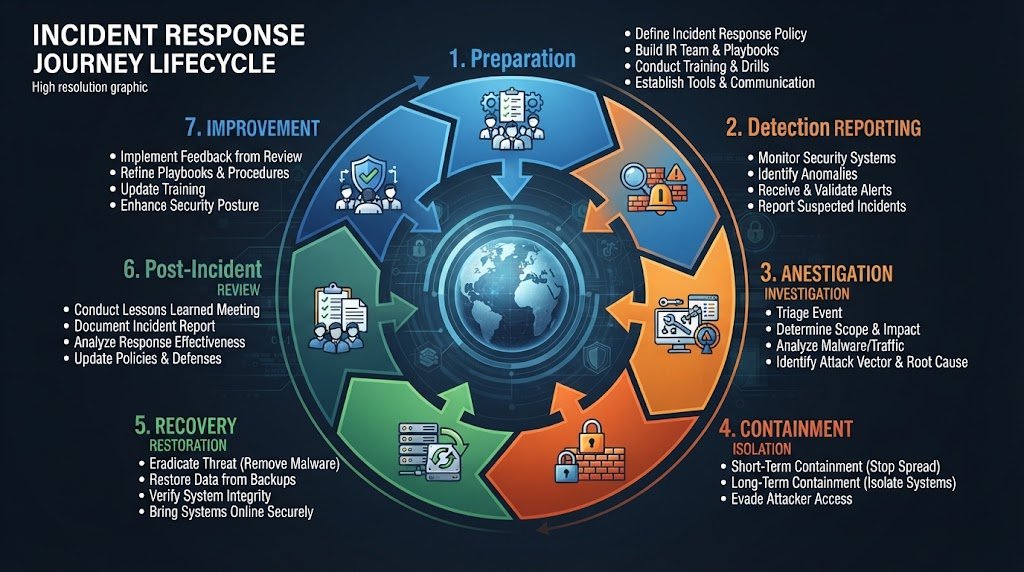
An effective incident response plan has several components.
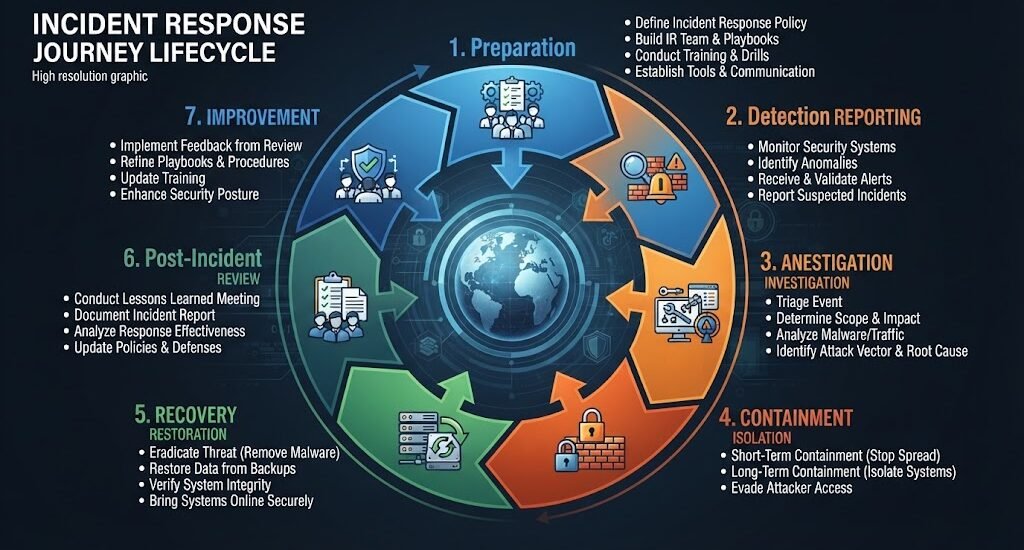
First is preparation. Before incidents happen, you assemble resources. You create incident response teams. You establish contact information. You create communication templates. You plan procedures. You test plans. Organizations that wait until incidents happen to create plans start from zero. Organizations that prepare in advance activate existing plans.
Second is detection and analysis. Someone notices something wrong. Systems behave unusually. Alerts fire. Employees report suspicious activity. Your incident response plan includes procedures for escalating findings to a central team. Instead of individuals investigating separately, a dedicated team analyzes what’s happening. They determine whether it’s a real incident or a false alarm.
Third is containment. Once you determine an attack is happening, you must stop it from spreading. Containment has two aspects: short-term containment to stop the attack immediately, and long-term containment to prevent recurrence. Short-term might mean isolating an infected computer. Long-term might mean patching the vulnerability the attacker exploited.
Fourth is communication. You notify stakeholders. This might include leadership, employees, customers, law enforcement, regulators, or the public. Different stakeholders need different messages at different times. Your plan includes communication templates and procedures.
Fifth is investigation. You determine what happened, how it happened, and what was accessed. This investigation is evidence collection for potential prosecution. It’s learning what defenses failed. It’s understanding the scope of compromise. Investigation must balance speed, you need to recover quickly, with thoroughness, you need to understand what happened.
Sixth is recovery. You restore systems from backups. You rebuild systems from scratch. You restore service. Recovery must be done carefully to ensure the attack vector is closed. Otherwise, attackers might reinfect systems.
Seventh is post-incident review. After the incident is contained and systems recovered, you review what happened. This is not blame assignment. It’s learning. What went well? What could improve? What were the root causes? What systemic changes prevent recurrence?
The First 24 Hours: Critical Actions
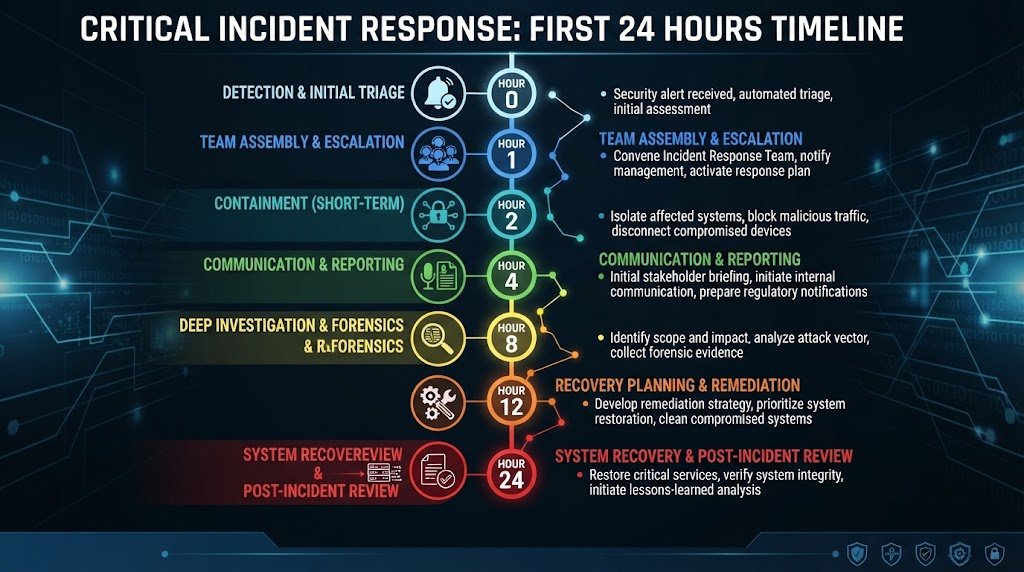
The first day of an incident is most critical. Decisions made in the first 24 hours determine much of the outcome. Here’s what should happen.
Hour zero: Someone notices an incident. A security alert fires. An employee reports suspicious activity. A customer calls about unauthorized charges. The first action is escalation. The report goes to the incident response team or security leadership. This person activates the incident response plan.
Hour one: The incident response team assembles. This might be security team members, IT leadership, legal counsel, communications staff, and others depending on the incident type. The team’s first task is confirmation. Is this actually an incident or a false alarm? What’s the scope? What systems are affected? Initial investigation happens immediately. Team members examine logs, interview the person who reported it, check for ongoing attacks.
Hour two: Initial containment. If the incident is confirmed, the team moves to contain it. For ransomware, this might mean isolating infected systems so the malware can’t spread. For credential compromise, it might mean disabling the compromised account. For data theft, it might mean blocking suspicious data transfers. The goal is to stop the attack immediately, even if full investigation isn’t complete.
Hour four: Communication begins. Leadership is notified. A decision is made about external communication. Do you notify customers immediately or investigate first? Do you contact law enforcement? Do you bring in external incident response professionals? Communication templates are activated. Messages are drafted. Stakeholders are informed.
Hour eight: Investigation continues. The incident response team works to understand what happened. What systems are affected? What data was accessed? How did the attacker get in? What tools did they use? This investigation informs recovery procedures and future prevention.
Hour twelve: Recovery planning. Based on investigation findings, the team creates a recovery plan. Which systems will be recovered first? Will systems be restored from backups or rebuilt? In what order? What testing happens before systems go back online?
Hour twenty-four: Recovery begins. Systems are restored. Data is recovered. Service is gradually brought back online. Investigation continues in parallel. The team monitors for signs of re-infection or continued attack.
These first 24 hours set the tone for the entire incident. Organizations that respond quickly and methodically contain damage quickly. Organizations that respond slowly or chaotically suffer much more.
Containment Strategies by Attack Type
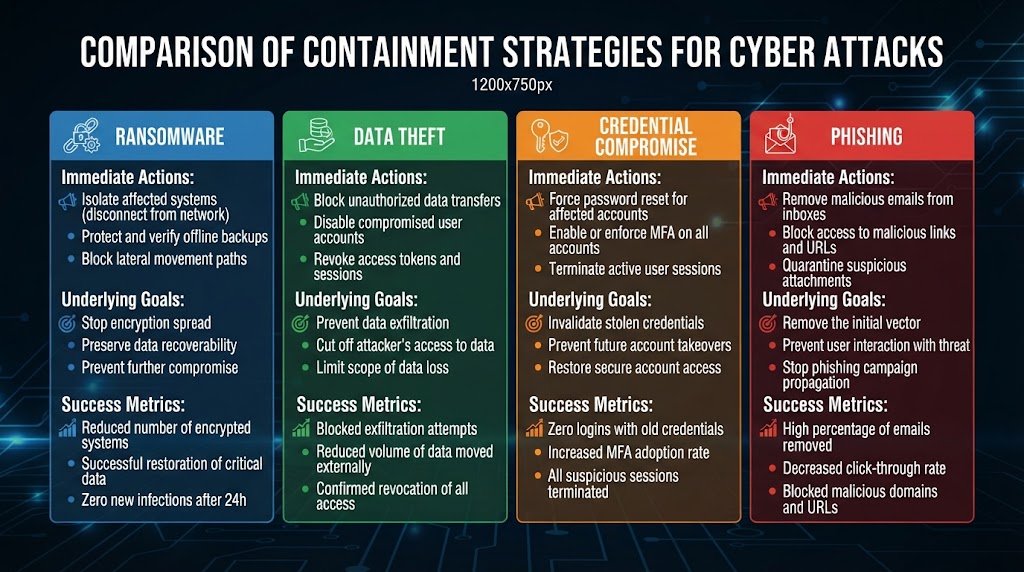
Different attacks require different containment strategies. Your incident response plan should address major attack types you’re most vulnerable to.
For ransomware, immediate containment means isolating infected systems so the malware can’t spread to other computers or network shares. Backups must be protected—ransomware often targets backup systems. Internet-facing systems might need to be taken offline to prevent re-infection. The goal is to stop encryption before it spreads everywhere.
For data theft, containment means blocking unauthorized data transfers. If you notice data being exfiltrated to an external IP address, you block that IP. You might disable accounts the attacker is using. You preserve evidence of what data was accessed so you can notify affected individuals. The goal is to stop data theft before all your data is stolen.
For credential compromise, containment means disabling compromised accounts. You reset passwords. You enable multi-factor authentication if not already enabled. You review account activity to see what the attacker accessed. You check for backdoors or persistence mechanisms the attacker installed. The goal is to prevent the attacker from maintaining access.
For phishing campaigns, containment means removing malicious emails from user inboxes. You identify the phishing email. You remove it from email systems. You quarantine similar emails. You block sender addresses and domains. You disable links the phishing email contains. You notify users not to click. The goal is to prevent more users from clicking and becoming infected.
Your incident response plan includes procedures for each attack type. Instead of deciding during an incident what to do, you follow proven procedures.
Communication During Incidents
Communication during incidents is critical and often mishandled. You must communicate with multiple stakeholders, each needing different information.
Internal communication keeps your organization functioning. Employees need to know what’s happening, what systems are affected, what they should do. If systems are down, they need to know alternative procedures. If they should watch for suspicious activity, they need to know what to look for. Clear internal communication prevents panic and maintains productivity.
External communication toward customers must be honest, timely, and appropriate. Customers need to know if their data was affected. They need to know what you’re doing about it. They need to know steps they should take. Most regulations require notification within specific timeframes. Your incident response plan includes communication templates and procedures for customer notification.
Communication with law enforcement is important for serious incidents. If ransomware hits, law enforcement wants to know. If financial fraud occurs, financial institutions want to know. If you suspect nation-state actors, government agencies want to know. Law enforcement can provide resources and might identify the attacker.
Communication with regulators depends on your industry. Healthcare organizations must notify health agencies. Financial institutions must notify banking regulators. Payment processors must notify networks. Compliance violations are serious. Your response plan includes procedures for regulatory notification.
Communication with the media should be minimal and carefully controlled. One spokesperson should handle all media inquiries. Statements should be brief and honest. Avoid admitting fault or liability, that’s for lawyers to determine. Protect your reputation by being transparent without being self-damaging.
Your incident response plan includes templates for each type of communication. During crises, people don’t create messages from scratch. You follow templates with placeholder information filled in.
Investigation and Forensics
Investigation during incidents serves multiple purposes. It determines scope of compromise. It identifies how attackers got in. It finds evidence for potential prosecution. It learns lessons to prevent recurrence. Investigation must be thorough but also timely—you need to recover while still investigating.
Investigation begins with log analysis. Your systems log activities. Servers log access attempts. Firewalls log traffic. Endpoints log process execution. These logs show what happened. Analysts search logs for evidence of the attack. When did it start? What systems were accessed? What data was transferred? Logs answer these questions.
Investigation also includes interview of affected people. Who first noticed the incident? What did they observe? Did they interact with suspicious emails? Did they notice unusual system behavior? These interviews often reveal attack details that logs don’t capture.
Investigation requires preserving evidence. Computers that were compromised become evidence. They shouldn’t be modified or cleaned until evidence is collected. Cloud-based systems should be backed up before being modified. This evidence might be needed for prosecution or insurance purposes.
Investigation should be done in coordination with legal counsel and potentially law enforcement. They advise on evidence preservation and investigation procedures. Mistakes during investigation might render evidence inadmissible in court or violate regulations.
Your incident response plan includes procedures for initiating investigation immediately. External forensics firms are contacted if needed. Evidence preservation procedures are followed. Investigation happens in parallel with recovery.
Recovery and Restoration
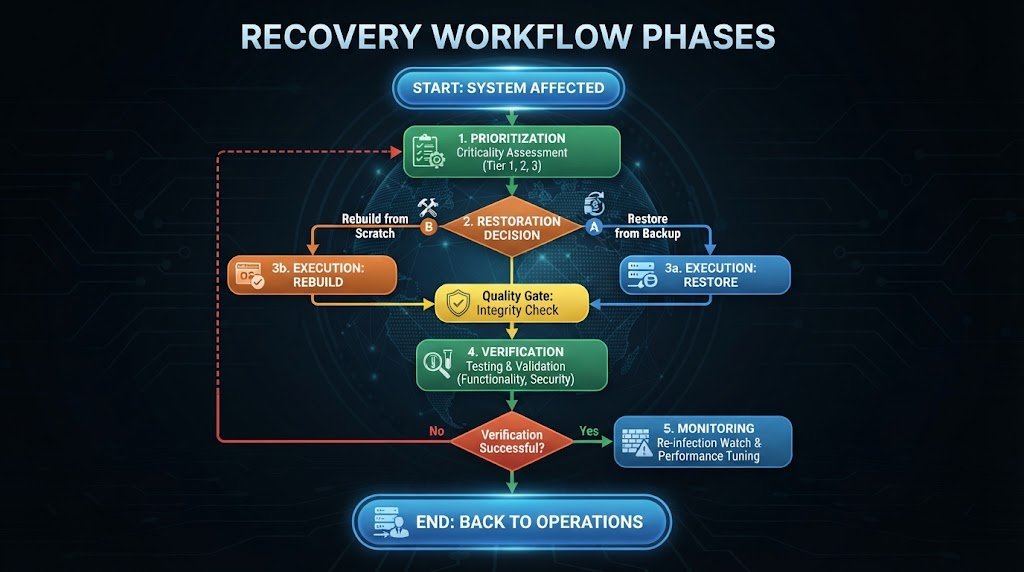
Recovery is returning to normal operations. This might mean restoring from backups, rebuilding systems from scratch, or both depending on the incident. Recovery must be careful to ensure the attack vector is closed.
If ransomware encrypted systems, you restore from backups. But which backups? Backups created after the attack was already underway might be infected with malware or corrupted files. You restore from backups you’re confident are clean. You verify that ransomware isn’t present in restored systems.
If systems were compromised, you might rebuild them rather than restore from backups that might be compromised. You install fresh operating systems. You install clean application software. You restore only data, not operating systems or applications. This ensures malware doesn’t come back.
Recovery is done in stages. You recover critical systems first. Essential business operations come back online. Less critical systems come back later. This prioritization ensures your organization can function quickly while still being thorough.
After recovery, you monitor systems carefully for signs of re-infection. If attackers had backdoors, they might exploit them to regain access. If underlying vulnerabilities weren’t patched, attackers might exploit them again. Monitoring catches re-infection quickly.
Post-Incident Review and Lessons Learned
After incidents are contained and systems recovered, you review what happened. This review is not punishment. It’s learning. What went well? What could improve? What were the root causes? What changes prevent recurrence?
Post-incident review examines the attack chain. How did attackers get in initially? What vulnerability did they exploit? What defense could have prevented it? If it was phishing, what training might have helped? If it was credential compromise, what access controls might have helped? If it was unpatched system, what patch management process would have helped?
Review also examines response. Did your response plan work? Did it need updating? Were roles and responsibilities clear? Did communication happen effectively? Did recovery go smoothly? Answers inform improvements to the plan.
Review also captures metrics. How long was the incident? How many systems were affected? How much data was exposed? How much did recovery cost? These metrics inform decisions about future security investments.
Organizations that perform thorough post-incident reviews learn from incidents. Organizations that rush through reviews miss the opportunity to improve. Your incident response plan includes procedures for post-incident review. This becomes part of your security culture.
Building Your Incident Response Plan
Building an incident response plan starts with assessment. What incidents are you most vulnerable to? What’s the potential impact? Based on this, you prioritize what to plan for. You probably can’t plan for every possible incident, but you can plan for the most likely and most damaging.
Next, you assemble your incident response team. This includes security professionals, IT leadership, legal counsel, communications staff, and executives. Different organizations structure this differently. The key is having people with different expertise ready to respond.
Third, you develop procedures for major incident types. For ransomware, you have a playbook. For data breach, you have a playbook. For insider threat, you have a playbook. These playbooks document the response process, who’s involved, what systems to isolate, who to notify, etc.
Fourth, you create templates. Communication templates, investigation checklists, recovery procedures, notification letters—having templates ready accelerates response during crises.
Fifth, you test your plan. Run tabletop exercises where your team simulates responding to incidents. Walk through your procedures. Find gaps. Update procedures. Testing in advance means your team is prepared when real incidents happen.
Sixth, you document everything and keep it updated. Plans that aren’t documented are just hope. Procedures change as systems change. Keep your plan current.
Seventh, you integrate incident response into your broader security program. Defenses that prevent incidents support incident response. Monitoring that detects incidents supports response. Backups that enable recovery support response. Everything works together.
Conclusion: Preparation Prevents Poor Performance
The adage “failing to plan is planning to fail” is nowhere more true than in incident response. Incidents will happen. Organizations with plans respond effectively. Organizations without plans suffer catastrophically. The difference is preparation.
Your incident response plan doesn’t prevent all incidents. It doesn’t eliminate their impact entirely. But it dramatically reduces damage. It enables quick recovery. It prevents panic decisions. It protects your organization.
Start building your incident response plan today. Assess your vulnerabilities. Assemble your team. Develop procedures. Test your plan. Update it regularly. When incidents happen, and they will, you’ll be ready.
This article is published exclusively for informational and educational purposes. Its goal is to enhance cybersecurity awareness, inform users, and help prevent modern digital threats.The information presented is not intended for malicious use or to promote illegal activities.
EXTERNAL LINKS:
Find more Cyber Security articles or contact us to learn how to better protect yourself, your business, and your digital environment from modern cyber threats. Also, explore How attackers bypass MFA to commit CEO fraud.
Understanding cyberattacks requires seeing the complete picture. It starts with research: attackers study you on LinkedIn and company websites using AI to craft personalized phishing emails. If you click, they gain access.
From there, they attempt to escalate privileges by exploiting weak passwords and ypassing multi-factor authentication using social engineering or technical weaknesses.
Business Email Compromise tactics impersonating executives and creating false urgency often accelerate this stage. Once deep in your network, they steal sensitive data before deploying ransomware or selling your information to identity thieves. The goal is always the same: money. Understanding how attackers think, which tactics work at each stage, and why your defenses matter is the foundation of real security.