
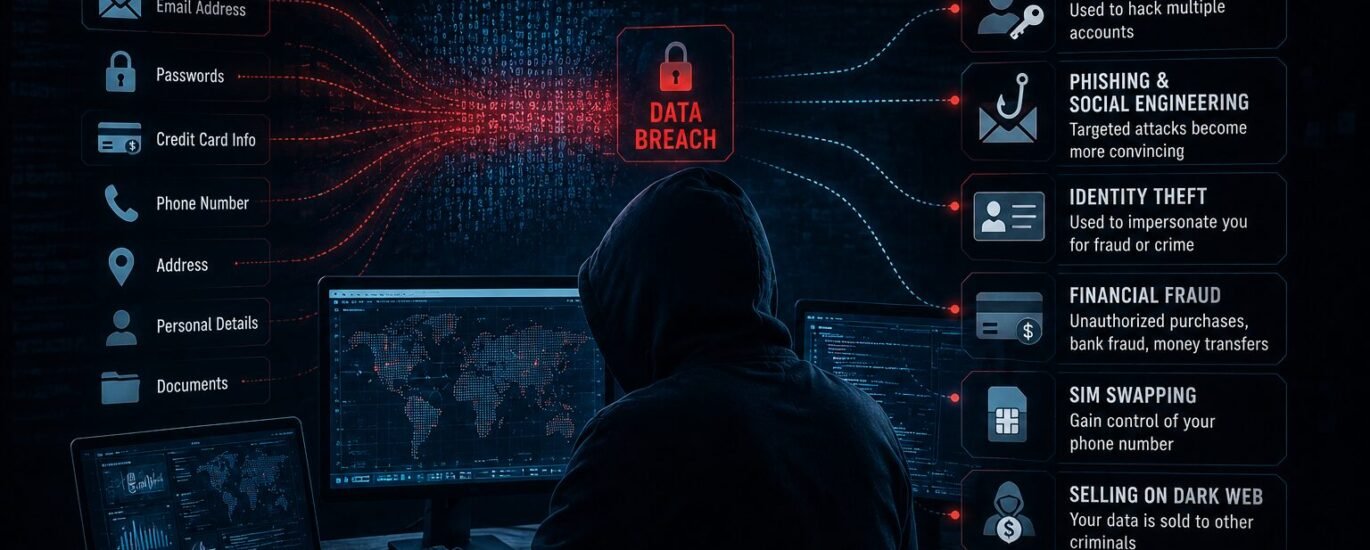
The Real Problem Begins After the Data Breach
One of the biggest misconceptions surrounding cyberattacks is that the danger ends the moment an account is compromised or a company announces a data breach. In reality, however, that is usually the point where the real exploitation of stolen data begins.
Stolen Data and personal information have gained enormous value in today’s digital world. Emails, passwords, phone numbers, photographs, banking details, and even everyday habits or information taken from social media can be transformed into a “digital product” that is sold and exploited by cybercriminals worldwide.
Hackers are not interested only in gaining access to a single account. In many cases, they attempt to build a complete digital profile of the victim, which can later be used for phishing attacks, financial fraud, social engineering, identity theft, or even deepfake scams. The most concerning aspect is that many users still believe they “have nothing important to hide,” without realizing how valuable even small pieces of information can become when combined together.
The Real Economy Behind Stolen Data and Cybercrime
For years, an entire underground economy has existed on the dark web based on stolen information. Massive leaks from companies, online platforms, and digital services create enormous databases that are bought, sold, and exchanged daily by organized cybercrime groups.
For cybercriminals, every piece of information has potential value. An email address can be used in phishing campaigns, a password can be tested across multiple platforms, and a phone number can be exploited for social engineering or SIM swapping attacks. Even seemingly harmless information gathered from social media helps attackers create more realistic and convincing scams.
The more complete a victim profile becomes, the more valuable it is. In many cases, hackers create full “identity packages” containing emails, passwords, phone numbers, addresses, financial details, and personal information, which are then sold to other attackers.
Stolen Data has become one of the most valuable currencies traded within underground dark web marketplaces.
When One Password Opens Multiple Accounts
One of the most common ways stolen data is exploited is through credential stuffing attacks. Attackers know that many people reuse the same password across multiple services and platforms.
This means that once a single account is breached, hackers can attempt to use the same email and password combination on social media platforms, cloud services, streaming accounts, online stores, or even professional business accounts. The process is usually automated through bots and can compromise thousands of accounts within minutes.
More information about password security can be found through CISA Password Guidance
Identity Theft Is Becoming Increasingly Common
Identity theft is now considered one of the most serious consequences of a data breach. Cybercriminals can use stolen personal information to create fake accounts, carry out financial fraud, or impersonate victims across online services and platforms.
In many situations, victims do not immediately realize that their information is being misused. The discovery often comes much later, when suspicious transactions, fake accounts, or even legal problems begin to appear.
As more aspects of everyday life become digital, the value of digital identity continues to grow, and so does the interest of cybercriminals in exploiting it.
Phishing Is Becoming More Personal and More Dangerous
Modern phishing attacks no longer resemble the poorly written emails and suspicious links of the past. The more information hackers possess, the more targeted and convincing their attacks become.
A phishing email containing the victim’s real name, work-related information, recent purchases, or social media details is far more likely to appear legitimate. Modern social engineering attacks rely heavily on this level of personalization and psychological manipulation.
More information about social engineering attacks can be found in the IBM Security
Financial Fraud Continues to Evolve
Financial information remains one of the most valuable targets for cybercriminals. Stolen data can be used for unauthorized online purchases, banking fraud, cryptocurrency scams, or money transfers through compromised accounts.
In many cases, these attacks are combined with social engineering techniques that allow attackers to bypass security procedures or manipulate customer support departments within banks and service providers.
These operations are becoming increasingly organized and are often supported by entire cybercrime networks that operate professionally and strategically.
Why Phone Numbers Have Become Extremely Valuable
Many users underestimate the importance of their phone number, but in reality, it has become a critical part of digital identity.
Through SIM swapping attacks, hackers attempt to gain control of a victim’s phone number by transferring it to a new SIM card. If successful, they can bypass SMS verification, password reset procedures, and even multi-factor authentication systems used by many online services.
As long as many platforms continue to rely on SMS-based authentication, these attacks will remain highly dangerous.
Artificial Intelligence Is Changing the Way Data Is Exploited
Artificial intelligence is now transforming the way stolen data is used. Photos, videos, voice samples, and social media information can be exploited to create deepfake scams, voice cloning attacks, and AI-generated phishing campaigns.
As AI tools continue to evolve, cybercriminals are able to produce increasingly realistic scams that become difficult to detect even for experienced users.
This means that the information people upload online every day is no longer used only for traditional cyberattacks, but also as “fuel” for entirely new forms of digital manipulation.
Stolen Data is now also being used for AI-powered scams and deepfake attacks.
Why Even “Unimportant” Data Matters
Many people believe they are not targets because they are “not famous” or because they “do not have much money.” In reality, however, most cyberattacks rely on mass data collection and automated exploitation processes.
Even small pieces of information can be combined to create a complete victim profile. A birth date, a photograph, a phone number, or an email address may become part of a much larger attack chain.
Cybercriminals do not always need perfect information. In many cases, only a few details are enough to begin a sequence of attacks that may eventually lead to serious financial or personal consequences.
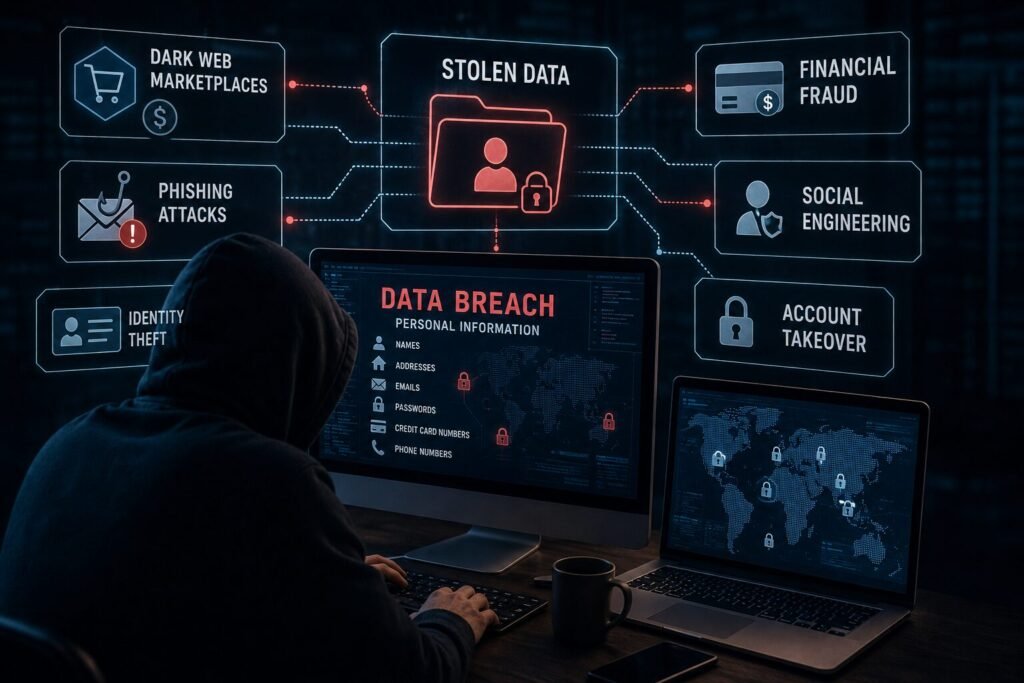
The Real Problem Begins After the Data Breach
Most people treat a data breach as a single isolated incident. In reality, stolen data can continue circulating and being exploited for years after the original breach occurred.
This means that even old passwords, email addresses, or personal information may reappear in future attacks long after the initial compromise.
Cybersecurity is no longer only about protecting devices or accounts. It is also about understanding the real value of personal information in a world where data has become one of the most valuable digital currencies.
Protecting Stolen Data and digital identity is now becoming a critical part of modern cybersecurity.

One thought on “Stolen Data: 9 DARK Ways Hackers Use them”