Why We Can No Longer Trust Everything We See and Hear
Artificial intelligence is evolving at a pace that would have seemed unimaginable just a few years ago. Tools that once required specialized laboratories and enormous computing power are now accessible to almost anyone with a computer and an internet connection. Alongside the impressive possibilities that AI brings to everyday life, business, and technology, a new generation of digital threats is also emerging — one that is becoming increasingly difficult to detect.
One of the most alarming developments in the field of cybersecurity is the rise of Deepfake Scams. These scams use artificial intelligence to create fake voices, videos, and images in an extremely realistic way. In many cases, the result is so convincing that even experienced users struggle to recognize that the content has been artificially generated.
These threats are no longer limited to experimental videos or internet jokes. They are already being used in financial fraud, social engineering attacks, phishing campaigns, and organized cyber operations targeting companies and organizations around the world. The most concerning aspect is that the technology is becoming more accessible, cheaper, and easier to use every day.
What Are Deepfakes and Why Are They Evolving So Quickly
The term “deepfake” comes from the combination of the words “deep learning” and “fake.” It refers to artificial intelligence technology capable of creating or manipulating audiovisual content so that it appears completely authentic.
Using machine learning algorithms, these systems can analyze photos, videos, and audio samples of a person and then generate entirely new content in which that person appears to speak, move, or say things that never actually happened.
What makes Deepfake Scams so dangerous is that they exploit something deeply human: our trust in what we see and hear. For decades, a voice on the phone or a video recording was considered strong evidence of authenticity. Today, that reality is changing dramatically.
The New Era of Social Engineering
Most cyberattacks do not rely solely on technical vulnerabilities but also on human psychology. Attackers understand that it is often easier to manipulate a person than to breach a well-protected system.
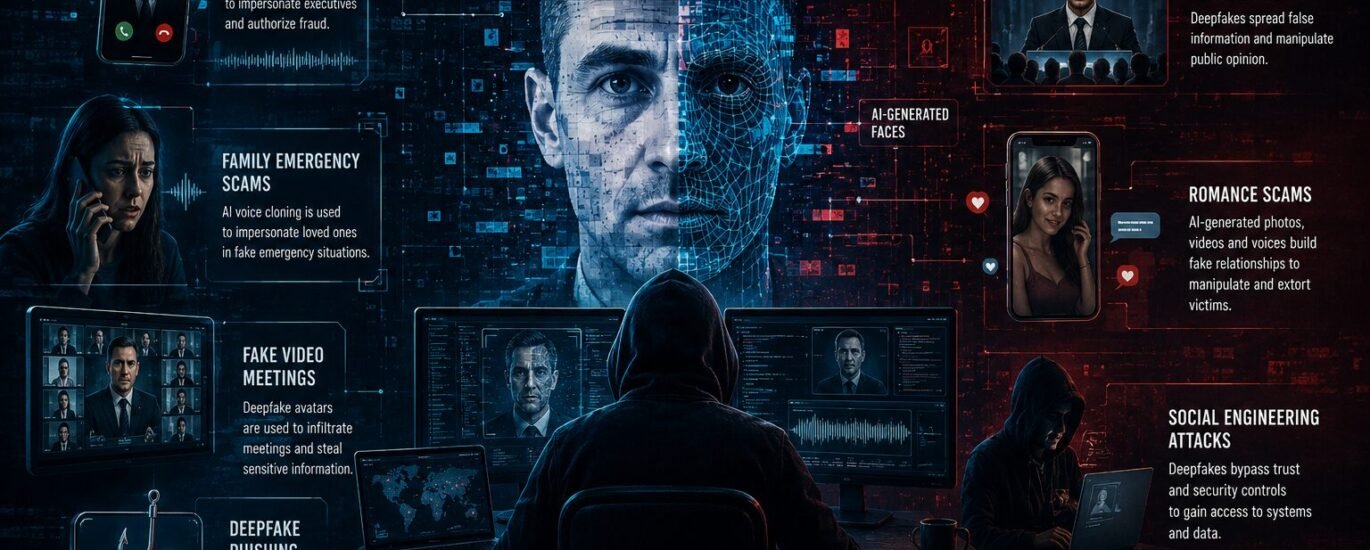
Deepfake Scams dramatically enhance this form of manipulation. When a scammer can imitate the voice of a company executive, a family member, or a trusted colleague, the attack becomes significantly more convincing and far more difficult to detect in time.
In many cases, attackers need only a few seconds of voice recordings or a handful of photos from social media profiles to create a realistic result. As more personal content is uploaded online every day, the “raw material” for these attacks continues to grow.
When the CEO’s Voice Is Not Real
One of the most well-known forms of Deepfake Scams involves so-called “Fake CEO” attacks. In these incidents, attackers use AI voice cloning to imitate senior business executives and deceive employees or partners.
Typically, the victim receives an urgent phone call or voice message from someone who sounds exactly like the company director or owner. The message often includes pressure, confidentiality, and an immediate request, such as transferring money or sending sensitive documents.
In several international cases, companies have lost hundreds of thousands of euros due to these attacks. The most dangerous element is that victims rarely question the voice they hear, especially when it includes familiar expressions or company terminology.

Deepfake Scams Targeting Families
These attacks are not limited to the corporate world. In recent years, there has also been a rise in scams where criminals use AI-generated voices to impersonate family members.
Victims receive a phone call from someone who sounds like a child, spouse, or close friend claiming to be in an emergency situation. The scenario usually involves an accident, arrest, hospitalization, or an urgent need for money.
Panic and emotional pressure often cause people to react before verifying the situation. Attackers rely precisely on this emotional response, knowing that fear and urgency can override logical thinking.
The Evolution of Phishing in the AI Era
Phishing is no longer limited to poorly written e-mails or suspicious links. Modern Deepfake Scams combine voice, video, images, and personalized messages to create attacks that are far more convincing than traditional phishing attempts.
An attacker can now send a fake video or voice message that appears to come from a real person, significantly increasing the chances of success.
More information about phishing can be found through CISA Cybersecurity Guidance
Disinformation and Manipulation of Public Opinion
Deepfakes are increasingly being used as tools of disinformation. Fake videos showing public figures making statements they never actually made can spread across social media within minutes and influence political, social, or economic developments.
As the technology becomes more advanced, distinguishing between authentic and fake content becomes increasingly difficult. This raises serious concerns not only for cybersecurity but also for the reliability of information in general.
How Can We Protect Ourselves
Although Deepfake Scams are evolving rapidly, awareness and digital vigilance remain among the most important forms of protection.
Users should never automatically trust a voice or image simply because it appears real. Any urgent financial request or demand for sensitive information should always be verified through a second communication channel.
At the same time, businesses must invest more in employee awareness and identity verification procedures. In a world where even a video call can be fake, cybersecurity culture becomes more important than ever.
The use of multi-factor authentication, approval procedures for financial transactions, and training against social engineering attacks can significantly reduce the risk.
More about social engineering techniques can be found in the IBM Security
The Future of Deepfake Scams
Experts believe that Deepfake Scams will increase significantly in the coming years. AI tools are becoming increasingly realistic while also becoming easier to use, meaning that these attacks will likely become more common and harder to detect.
Cybersecurity is no longer only about firewalls, antivirus software, and technical protection measures. It is also about the ability of individuals to recognize digital manipulation and question what they see and hear online.
In an era where reality itself can be manufactured by algorithms, information verification and digital critical thinking will become essential tools for defending against the cyber threats of the future.
Find more Cyber Security Articles , or contact us to learn how to better protect yourself, your business, and your digital environment from modern cyber threats.