Shadow AI Inside Modern Businesses
Artificial intelligence has rapidly entered the modern business environment and is fundamentally changing the way employees communicate, organize information, and manage their daily work. From emails and reports to data analysis and content creation, AI tools are now being used every day across thousands of businesses worldwide.
Within this new reality, however, a growing threat is emerging that many companies still underestimate. It is called Shadow AI and is already considered one of the most significant new challenges in cybersecurity and data protection.
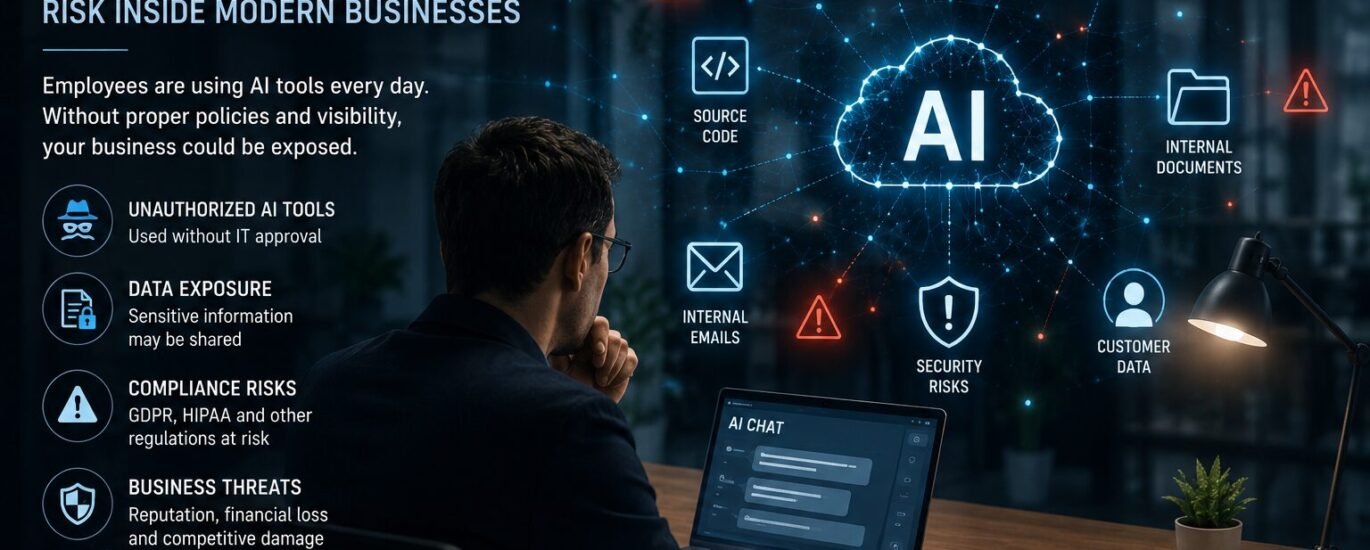
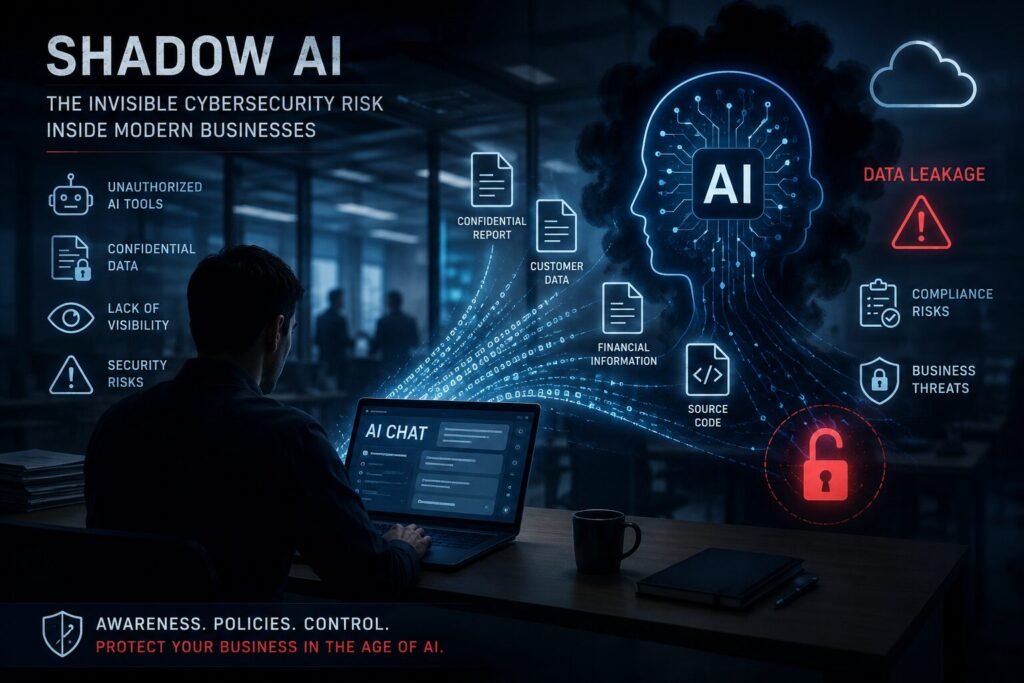
Shadow AI refers to the use of artificial intelligence tools by employees without official approval, security policies, or oversight from the organization. In many cases, users upload confidential documents, internal emails, financial information, or sensitive business data to AI platforms without fully understanding the potential risks involved.
The most concerning aspect is that Shadow AI is usually not driven by malicious intent. Most employees simply use AI tools in an attempt to become more productive or complete tasks more efficiently. Nevertheless, even seemingly harmless AI usage can create serious security issues, data leakage risks, and compliance concerns.
What Shadow AI Really Means
Shadow AI closely resembles the concept of “Shadow IT,” where employees use applications or cloud services without approval from the IT department. In the case of AI, however, the risks are often more complex and significantly harder to detect.
An employee may copy confidential business information, financial data, source code, contracts, or customer records into an AI chatbot in order to generate summaries, reports, or new content. In many situations, however, this information may be stored or processed by third-party services without the user fully realizing it.
As the adoption of AI tools continues to grow at an extremely rapid pace, many organizations are now struggling to understand which data is leaving the corporate environment and who may ultimately gain access to it.
When Productivity Creates New Risks
The popularity of AI tools is largely driven by the speed and convenience they provide. Tasks that once required hours of work can now be completed within seconds.
That same convenience, however, often leads to risky behavior. When employees feel pressure to work faster or improve productivity, they may unintentionally bypass essential security procedures.
In several international cases, employees have uploaded:
- confidential reports,
- source code,
- business plans,
- customer personal data,
- and even medical or legal information
The problem is that many businesses are not even aware that this activity is taking place inside their organizations.
Shadow AI and Data Leakage
One of the most serious risks associated with Shadow AI is invisible data leakage. Unlike a traditional cyberattack where a breach is immediately visible, in this case information often leaves the organization gradually and without malicious intent.
This creates major concerns involving:
- data privacy,
- GDPR compliance,
- intellectual property protection,
- and overall business security.
A seemingly simple action, such as copying a confidential document into an AI chatbot to generate a summary or analysis, may lead to uncontrolled exposure of sensitive business information.
As organizations increasingly rely on cloud-based tools and remote collaboration platforms, visibility into how information flows outside the business environment becomes more limited.
Shadow AI and Modern Cybersecurity
Shadow AI is not only a privacy issue but also a significant cybersecurity risk. Attackers already understand that employees are relying more heavily on AI tools and are actively attempting to exploit this new reality.
Malicious AI platforms or fake AI tools may be used for:
- phishing attacks,
- credential theft,
- malware delivery,
- or corporate data collection.
At the same time, excessive trust in AI-generated content may lead to misinformation, poor decision-making, or accidental exposure of sensitive information.
Cybersecurity is no longer only about firewalls and antivirus systems. It is also about the way people interact with artificial intelligence technologies.
More information regarding AI cybersecurity risks can be found through ENISA Artificial Intelligence Threat Landscape
Why Many Businesses Are Not Prepared
Despite the rapid expansion of AI, many businesses still do not have clear policies regarding the use of artificial intelligence tools.
In many organizations:
- there are no AI usage policies,
- no employee awareness training,
- no monitoring procedures,
- and no clear rules regarding which data can be used within AI platforms.
This creates a “gray area” where employees make independent decisions without fully understanding the possible consequences.
As a result, many companies expose themselves to risks that often remain invisible until a serious security incident occurs.
The Human Factor Behind Shadow AI
Shadow AI once again demonstrates that the human factor remains one of the most important pillars of cybersecurity.
Most employees are not intentionally attempting to violate security policies. On the contrary, they believe they are using “smart” tools to improve efficiency and simplify their work. However, the lack of awareness combined with the rapid evolution of AI creates an environment where mistakes become extremely easy to make.
This means that addressing Shadow AI cannot rely solely on restrictions or technical controls. It requires a combination of awareness, employee education, corporate policies, and a strong cybersecurity culture.
More information regarding social engineering and human-centric cyber threats can be found in the IBM Security Guide
How Businesses Can Protect Themselves
Organizations that want to reduce the risks associated with Shadow AI must first recognize that employee use of AI tools is now unavoidable.
Instead of attempting to completely ban AI usage, many businesses are moving toward more realistic strategies that include:
- AI usage policies,
- employee awareness training,
- data classification,
- monitoring procedures,
- and controlled access to approved AI tools.
Proper employee education is perhaps the most important layer of protection. The more employees understand the risks of Shadow AI, the lower the chances of accidentally exposing sensitive information.
The Future of Shadow AI
Shadow AI is expected to become one of the most important cybersecurity challenges of the coming years. As AI tools become more powerful, easier to use, and more integrated into everyday business operations, organizations will need to rethink the way they approach cybersecurity and information management.
The real challenge is not artificial intelligence itself, but the uncontrolled use of AI without clear policies, employee awareness, and organizational visibility.
In a world where artificial intelligence is becoming part of nearly every business process, Shadow AI proves that even the most useful technological tools can become serious cybersecurity risks when used without proper oversight.