Ethical Hacking: When most people hear the word “hackers,” they usually imagine a criminal trying to break into computers, steal data, or cause damage to organizations and businesses. This perception has been largely shaped by movies, television series, and news reports that associate hacking exclusively with illegal activities.
The reality, however, is far more complex. In the field of cybersecurity, hacking is not necessarily a criminal activity. On the contrary, many of the techniques used by cybercriminals are also utilized by security professionals to protect systems, networks, and organizations.
This is why terms such as Ethical Hacking, Penetration Testing, and Red Teaming have become increasingly important in recent years.
What Is Ethical Hacking?
Ethical Hacking is the process through which authorized security professionals attempt to identify weaknesses in systems, applications, or networks before malicious attackers can exploit them.
Simply put, Ethical Hackers think and operate like real attackers, but they work with the organization's permission and with the goal of improving security.
Today, Ethical Hacking is a fundamental component of cybersecurity programs across businesses, government organizations, and critical infrastructure worldwide.
The Different Types of Hackers
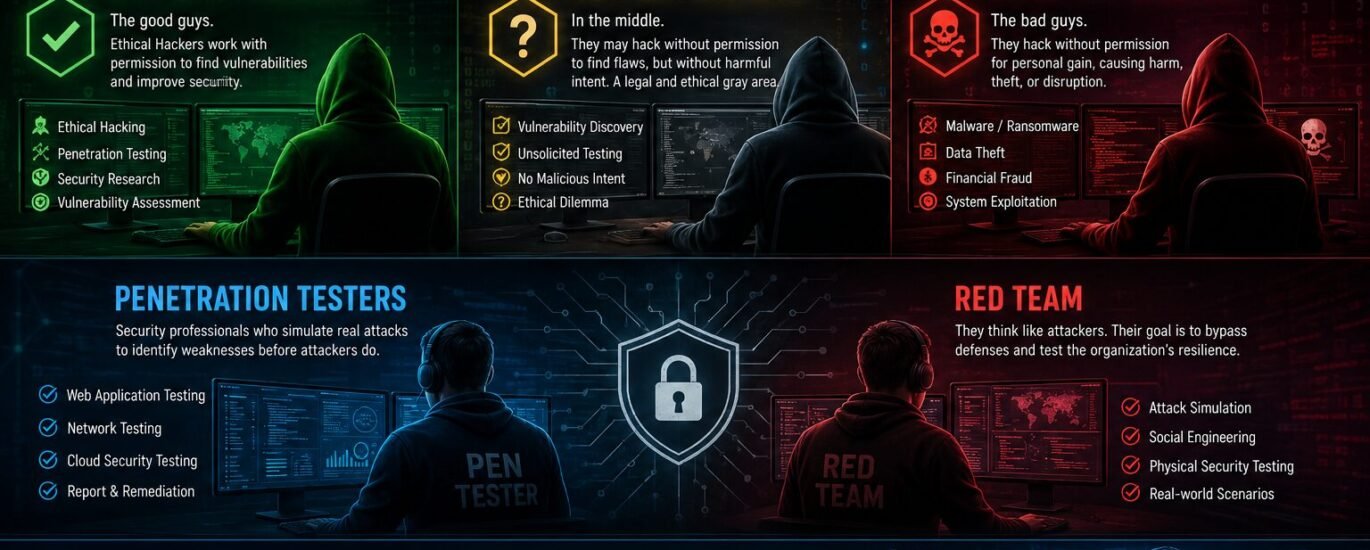
Although the term "hacker" is often used as a general description, there are actually several categories of hackers that differ significantly in terms of motivation and activities.
White Hat Hackers
White Hat Hackers are cybersecurity professionals who use their skills to identify vulnerabilities and help organizations defend themselves against attacks.
Most Penetration Testers, Security Consultants, and Red Team Operators belong to this category.
Black Hat Hackers
Black Hat Hackers are cybercriminals who conduct unauthorized attacks for financial gain, espionage, extortion, or data theft.
Ransomware attacks, data breaches, and many of the cyberattacks we encounter today are carried out by Black Hat Hacker groups.
Grey Hat Hackers
Grey Hat Hackers operate in a "gray area." They may discover vulnerabilities or test systems without authorization, but not necessarily with malicious intent.
Although their actions may aim to expose security weaknesses, they still raise legal and ethical concerns.
What Do Penetration Testers Do?
Penetration Testers, often referred to as Pentesters, conduct controlled attacks against systems and applications in order to identify security weaknesses.
During a penetration test, areas such as the following are assessed:
- Web applications
- Networks
- Cloud environments
- Mobile applications
- Authentication systems
The objective is not to cause damage but to evaluate the real risks facing an organization.
What Are Red Teams?
Red Teams represent a more advanced form of security assessment.
Unlike a traditional penetration test, which primarily focuses on technical vulnerabilities, a Red Team engagement simulates a real-world attacker.
These teams may use:
- phishing,
- social engineering,
- Physical access techniques
- Network intrusion methods
- Security control bypass techniques
The goal is to evaluate not only technology, but also the people and processes within an organization.
Red Team vs Blue Team
In cybersecurity, the concepts of Red Teams and Blue Teams are frequently used.
The Red Team acts as the attacker and attempts to identify weaknesses.
The Blue Team represents the defensive side and is responsible for:
- Attack detection
- System monitoring
- Incident response
- Infrastructure protection
The collaboration between these two teams plays a critical role in improving an organization's overall cybersecurity posture.
Why Ethical Hacking Is Important Today
Cyberattacks are becoming increasingly sophisticated. Organizations can no longer rely solely on firewalls, antivirus software, or traditional security measures.
Ethical Hacking enables organizations to discover vulnerabilities before real attackers do.
The same philosophy lies behind:
- Penetration testing
- Red Team exercises
- Bug bounty programs
- Modern cybersecurity programs
NIST Cybersecurity Framework
Useful inside the Red Team section: NIST
The Future of Ethical Hacking
As artificial intelligence, cloud computing, and digital services continue to evolve, the demand for Ethical Hacking will continue to grow.
Organizations increasingly need professionals who can think like attackers, identify weaknesses, and contribute to the protection of critical systems and sensitive data.
In a world where cyber threats continue to increase every day, Ethical Hackers, Penetration Testers, and Red Teams play a vital role in defending against modern digital threats.
CISA Cybersecurity Resources https://www.cisa.gov/
Find more Cyber Security Articles , or contact us to learn how to better protect yourself, your business, and your digital environment from modern cyber threats.
Legal & Ethical Use Notice
The content provided on this website is intended for informational and educational purposes only. Any security techniques, tools, methodologies, or demonstrations discussed should be used solely in a lawful, ethical, and authorized manner. Users are responsible for ensuring compliance with all applicable laws, regulations, and organizational policies. The authors and website owners assume no responsibility for any misuse of the information provided.