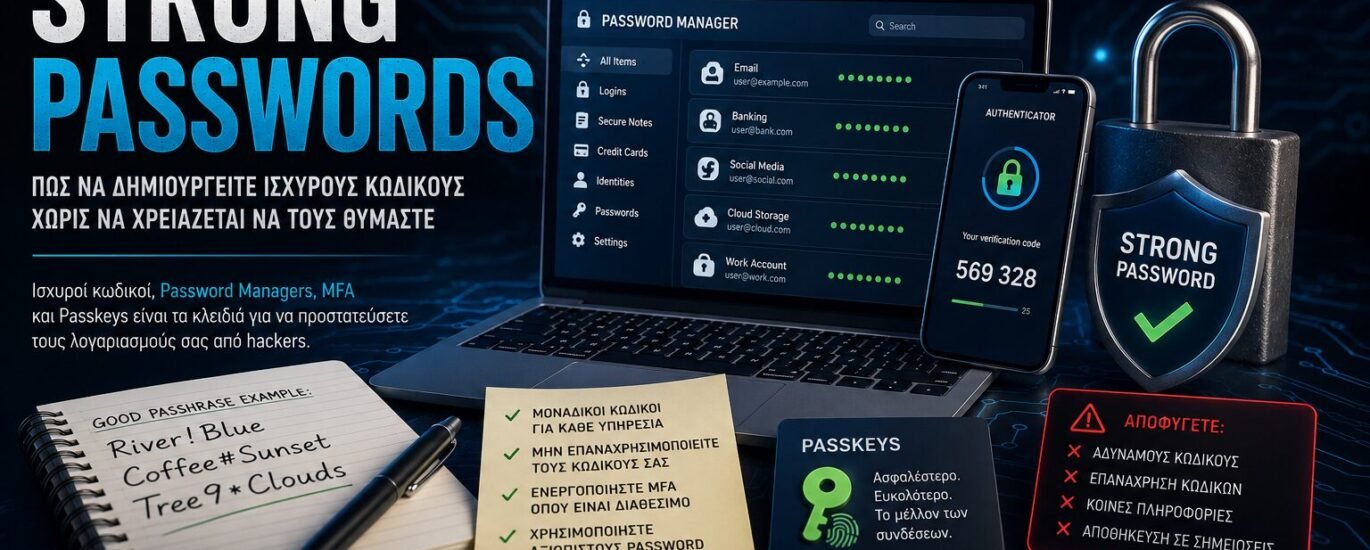
Τα Strong Passwords, are one of the most basic levels of protection for our digital lives. Every day, we use dozens of online accounts for email, social media, online shopping, banking services, cloud applications and professional platforms. Each one of these accounts represents a potential target for cybercriminals.
The problem is that most people still use simple passwords, reuse the same password across multiple services or create variations of a basic password that can easily be predicted. At the same time, the need to remember dozens of different passwords often leads to practices that significantly reduce security.
The solution is not to try to remember more and more passwords. The real solution is to create Strong Passwords,use a different password for every service and leave their storage and management to a reliable tool.
Why Do Most People Use Weak Passwords?
One of the main reasons is human nature. People prefer something they can easily remember, even when it is not secure.
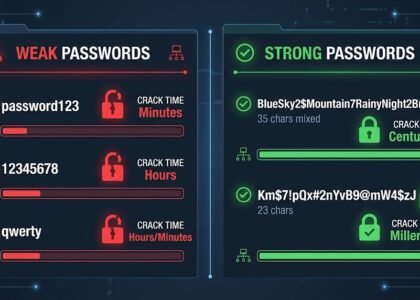
Names, dates of birth, pet names, favorite sports teams, phone numbers or simple sequences of characters are often used as passwords. Even when someone adds a number or a symbol, for example changing password σε Password123!, this does not necessarily mean that they have created a truly strong password.
Cybercriminals know that users follow predictable patterns. At the same time, when a service suffers a Data Breachleaked passwords or other login credentials may be used in subsequent attacks.
For this reason, the concept of Strong Passwords, is not only about creating a "complex" password. It is mainly about creating unique and difficult-to-predict credentials for every account.
Why You Shouldn't Use the Same Password Everywhere
Password reuse is one of the most dangerous habits in digital security.
Let's assume that you use the same password for your email, a forum you rarely use and an online store. If that particular store suffers a breach and the login credentials are leaked, an attacker may try the same email address and password on other services.
Αυτή η τεχνική είναι γνωστή ως Credential Stuffing.Attackers use credentials obtained from previous data breaches and automatically test them against other platforms.
This technique is known as Strong Passwords,A unique password for every account works like a separate key. If one key is stolen, it does not open all the other doors.
As we have also discussed in our article about Stolen Data, personal data breaches can create long-term risks for users. For this reason, using a different password for every service is one of the most important basic cybersecurity practices.
Strong Passwords or Passphrases;
When we talk about Strong Passwords,many people imagine a huge combination of random characters that is almost impossible to remember.
In reality, a Passphrasemeaning a longer phrase made up of multiple words, can be much easier to use and provide significant security when created correctly.
The important thing is to avoid common phrases, well-known expressions or personal information that can be predicted. A passphrase should be sufficiently long, unique and should not have been used for another service.
However, there is an even better approach for everyday use. Instead of trying to create and remember dozens of Strong Passwords,you can use a reliable password manager.
Password Managers: The Solution to Remembering Dozens of Passwords
A Password Manager works like a digital vault for your credentials.
Instead of using one password that you remember and reuse everywhere, a password manager can generate different and strong passwords for every service. It then stores them securely so you do not need to remember them all.
This means you can have one unique password for your email, another for banking services, a third for social media and different passwords for every online service.
The only password you really need to remember is usually the Master Password that protects your password manager.
This, however, means that your Master Password becomes particularly important. It must be unique, strong and never used for any other service.
A password manager is not simply a convenience tool. It is a way to put the principle of Strong Passwords, and credential uniqueness into practice without having to rely on your memory.
MFA: What Happens If Someone Steals Your Password?
Even the best Strong Passwords, do not provide absolute protection.
A password can be stolen through phishing, malware, a data breach or other attacks. For this reason, it is important to have an additional layer of protection.
This is where Multi-Factor Authentication (MFA) comes in..
With MFA, logging into an account does not rely exclusively on a password. An additional verification factor is required, such as a code from an authenticator app, a security key or another verification method.
This means that even if an attacker obtains your password, they may still be unable to access your account.
For this reason, the best approach is not Strong Passwords instead of MFAbut Strong Passwords together with MFA..
Passkeys: The Next Step Beyond Passwords
In recent years, a new technology has been gradually changing the way we log into online services: Passkeys,.
Unlike traditional passwords, passkeys are based on cryptographic keys and allow users to sign in using the method they use to unlock their device, such as biometric authentication or a PIN. The technology is based on FIDO standards and is designed to be resistant to phishing attacks.
In simple terms, instead of typing a password that can be stolen or exposed through phishing, your device uses a cryptographic key pair to prove your identity.
Passkeys do not mean that passwords will disappear overnight. However, they represent an important step toward a future where the need for traditional passwords will gradually decrease. The FIDO Alliance states that passkeys are designed to be unique to each service and resistant to phishing, while they can be used across different devices depending on how they are managed.
For those who want to learn more about the technology, the FIDO Alliance – Passkeys is one of the most specialized resources available on the subject.
How to Create Strong Passwords Without Memorizing Them
The best approach is to create a simple and consistent system for protecting your accounts.
tart by choosing a reliable password manager and create a truly strong and unique Master Password. Then, use the password manager to create different Strong Passwords, for every service.
Do not reuse passwords across different accounts. If a password has been used for more than one service, gradually replace it with unique passwords.
Enable MFA on all your important accounts, starting with your email, banking services, social media and accounts that are used to recover access to other services.
Also, check whether your important accounts support Passkeys,Where this option is available and you understand how it works, it can provide a more modern and phishing-resistant method of authentication.
Finally, regularly check whether your email address has appeared in known data breaches. As we explained in our guide, How to Check if Your Email Has Been Leaked, being informed early can give you enough time to change your credentials and protect your accounts before a more serious incident occurs.
Strong Passwords: Security Is About More Than Just a Good Password
One of the biggest mistakes is assuming that cybersecurity depends exclusively on a password.
In reality, protecting an account involves a combination of different practices. A unique and strong password, MFA, the use of a password manager, caution against phishing attacks and, where supported, the adoption of passkeys can create a much stronger level of protection.
Technology is changing and attacks are evolving. Cybercriminals are no longer simply trying to "guess" a password. They exploit data breaches, phishing, credential stuffing and social engineering to gain access to accounts.
For this reason, the right strategy is to create Strong Passwords,, while also using multiple layers of defense.
Conclusion
Τα Strong Passwords, remain one of the most important foundations of digital security. However, real protection does not require us to remember dozens of complicated passwords.
Using a reliable Password Manager, creating unique passwords for every service, enabling Multi-Factor Authentication and gradually adopting Passkeys, can significantly change the way we protect our digital identities.
The most important thing is to stop treating passwords as something we simply have to remember. Strong Passwords, are part of a comprehensive cybersecurity strategy that includes prevention, awareness and proper management of our digital identities.
As we have also discussed in our articles about Stolen Data, The Dark Web, Ethical Hacking,, τα QR Code Scams (Quishing) and checking for email data breaches, attacks often begin with a seemingly small mistake. Proper password management is one of the simplest yet most important steps we can take to reduce our risk.
Find more Cyber Security articles or contact us to learn more about cybersecurity awareness, digital privacy, online safety, password security and modern cyber threats.
This article is published exclusively for informational and educational purposes. Its goal is to promote awareness and understanding of cybersecurity, safe internet use and the protection of digital accounts. The information presented is not intended to promote offensive or illegal activities, but rather to support prevention and protect users against modern digital threats.