
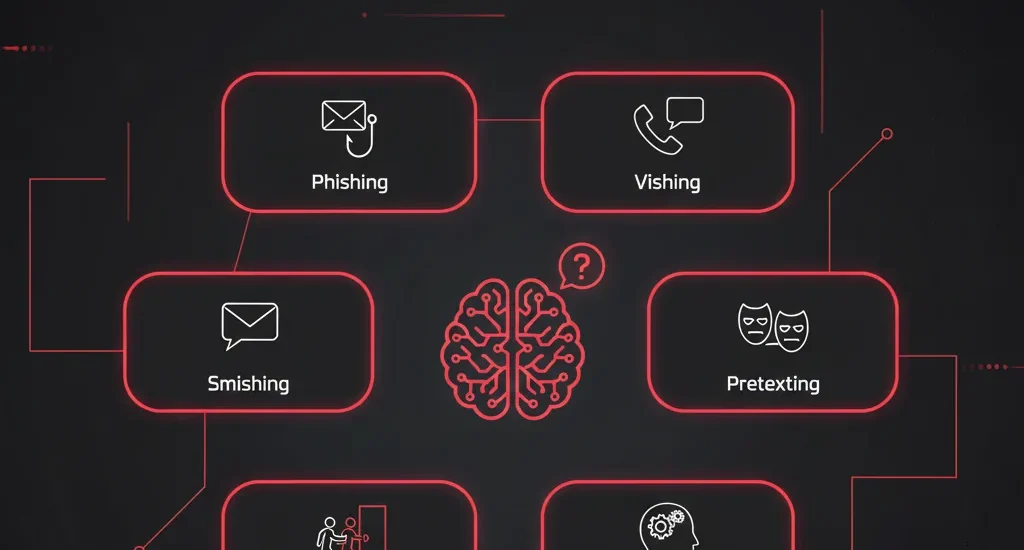
Social engineering is one of the most effective and dangerous forms of cyberattack because it does not directly target technical systems — it targets people themselves.
Instead of attempting to bypass firewalls or exploit technical vulnerabilities, attackers rely on psychological manipulation to convince victims to reveal sensitive information or perform actions they would not normally take.
Human psychology — rather than technology — becomes the attacker’s primary weapon.
What Is Social Engineering?
Social engineering refers to the manipulation of individuals in order to:
- gain unauthorized access
- steal information
- compromise credentials
- or bypass security mechanisms
These attacks primarily rely on:
- trust
- fear
- urgency
- curiosity
- and the lack of information verification
People often react emotionally or under pressure, bypassing logical verification processes. This is precisely what attackers exploit.
Main Types of Social Engineering Attacks
Social engineering attacks appear in many different forms.
Phishing & Spear Phishing
Phishing.
Mass deception attempts delivered through emails or messages designed to steal:
- passwords
- banking information
- personal data
- credentials
Phishing messages commonly impersonate:
- banks
- courier companies
- public services
- popular online platforms
Spear Phishing
Spear phishing involves highly targeted attacks against specific individuals or organizations.
These messages are personalized and often include:
- real names
- corporate information
- social media details
- data obtained from previous breaches
This significantly increases the credibility of the attack.
Vishing – Voice Phishing Attacks
In vishing attacks, threat actors use phone calls to obtain sensitive information or unauthorized access.
Attackers frequently impersonate:
- banks
- technical support teams
- public services
- coworkers or business partners
The objective is to create a sense of trust or urgency so the victim reveals sensitive information.
Smishing – SMS-Based Attacks
Smishing attacks use SMS messages to persuade victims to:
- open malicious links
- install malware
- reveal credentials or banking information
These messages often appear as:
- delivery notifications
- banking alerts
- urgent security warnings
Pretexting
In pretexting attacks, the attacker creates a fake scenario or identity in order to gain trust.
Examples include:
- auditors
- IT staff
- accounting personnel
- security officers
Through this fabricated scenario, attackers attempt to gain access to information or systems.
Tailgating & Impersonation
Tailgating
The attacker gains physical access by following an authorized individual into a restricted area.
Impersonation
The attacker pretends to be a trusted person in order to obtain:
- access
- information
- privileges
- physical or digital entry
How Attackers Exploit Human Psychology
Hackers primarily rely on psychological manipulation to bypass critical thinking.
The most common tactics include:
Trust
Users are more likely to follow instructions from individuals who appear trustworthy.
Fear & Urgency
Attackers create pressure and urgency to force victims into making rushed decisions.
Curiosity
Messages such as:
- “See who mentioned you”
- “Open this document”
- “Urgent security notification”
are designed to trigger human curiosity.
Lack of Verification
Many users fail to verify:
- URLs
- domains
- identities
- and the authenticity of requests
before taking action.
Defending Against Social Engineering
Protection against social engineering attacks requires a combination of:
- awareness
- education
- security procedures
- and technical safeguards
Security Awareness Training
Users should be trained to recognize:
- phishing emails
- suspicious calls
- malicious links
- impersonation attempts
Verification Procedures
Any request involving:
- credentials
- payments
- access changes
- or sensitive information
should always be verified through secure and trusted communication channels.
Simulated Phishing Campaigns
Phishing simulations help organizations:
- identify weaknesses
- educate employees
- improve awareness
- assess user readiness
MFA & Technical Controls
Multi-Factor Authentication (MFA) significantly reduces the risk of compromise even if credentials are stolen.
Additionally:
- email filtering
- behavioral analytics
- access monitoring
- endpoint protection
strengthen defenses against social engineering attacks.
Conclusion
Social engineering is one of the most deceptive forms of cyberattack because it exploits the weakest link in any organization: the human factor.
Even the most advanced technical security systems can be bypassed through:
- deception
- manipulation
- psychological pressure
- or human error
Effective defense against these threats requires:
- continuous awareness
- awareness
- user education
- proper procedures
- and strong technical security controls
Awareness is the first — and most important — step toward defending against attacks that exploit human psychology and everyday interaction with technology.

One thought on “Social Engineering – Όταν ο Hacker Επιτίθεται στον Άνθρωπο”