
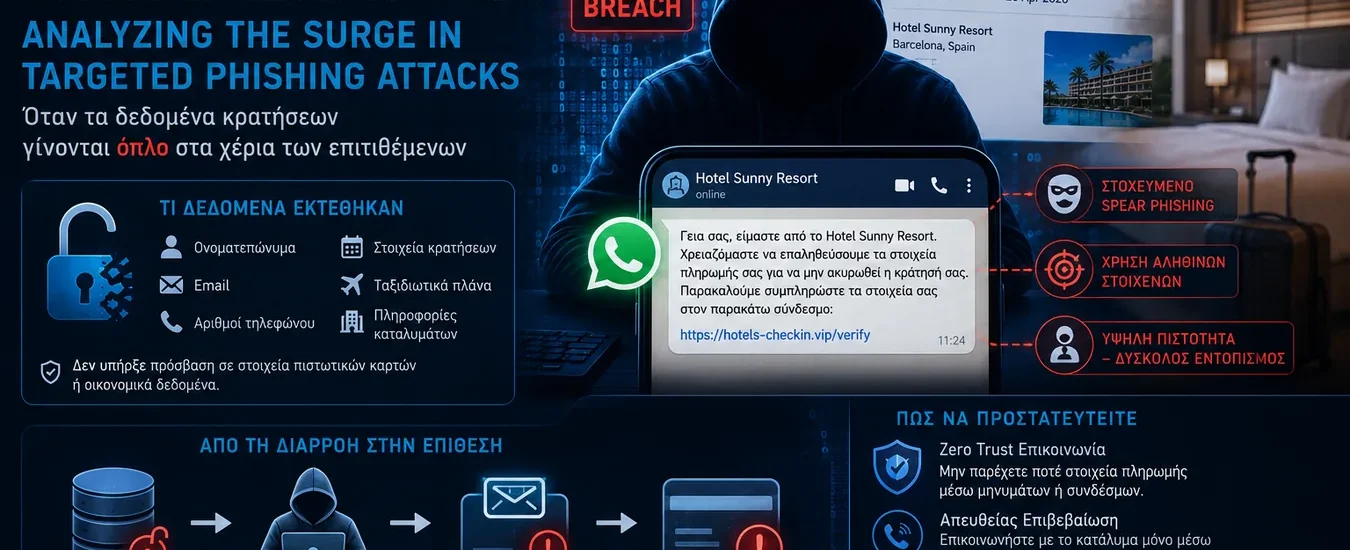
When Booking Data Becomes a Weapon in the Hands of Attackers
The recent cyberattack involving Booking.com in April 2026 brought a critical cybersecurity issue back into the spotlight: even the world’s largest digital platforms can become sources of highly targeted social engineering attacks.
This incident goes far beyond a “typical” data breach. Instead, it serves as a clear example of how personal information and booking details can be weaponized to launch highly targeted phishing campaigns.
The real threat lies not only in the exposure of information itself, but in how that information can be leveraged to create convincing and nearly invisible attacks.
The Breach and the Exposed Data
According to available security reports, attackers gained access to:
- user full names
- email addresses
- phone numbers
- booking details
- travel itineraries
- accommodation and date information
Although there has been no official confirmation regarding leaked credit card or banking information, the exposed data still carries extremely high value.
Knowledge of:
- travel destinations
- booking dates
- hotel names
- and legitimate reservation details
gives attackers the ability to craft exceptionally convincing phishing scenarios.
This is a clear example of how even “non-financial” information can become a serious security risk.
From Data Breach to Spear Phishing
The most alarming aspect of the incident is how quickly the stolen information was used in real-world attacks.
Many users reported receiving:
- WhatsApp messages
- emails
- or messages through booking chat systems
from individuals impersonating:
- hotel staff
- support agents
- or booking representatives
The messages requested:
- payment “verification”
- card confirmation
- or additional payments to avoid reservation cancellation
The difference compared to traditional phishing attacks is critical.
The attackers already knew:
- the real booking number
- travel dates
- accommodation names
- and legitimate customer information
This transforms phishing into a highly targeted spear phishing attack, making it significantly harder for average users to recognize the threat.
Why These Attacks Are So Effective
Most phishing attacks fail because they appear obviously fake.
In this case, however:
- the data was real
- the travel information was legitimate
- and the timing was highly convincing
Attackers no longer need to guess information — they already possess it.
This creates:
- a sense of trust
- an illusion of legitimacy
- and urgency
especially when users are close to their travel dates or check-in times.
Modern social engineering increasingly relies on real-world data obtained through previous breaches.
Zero Trust Communication
One of the most important lessons from this incident is that even trusted platforms alone are not enough to guarantee user security.
Η σύγχρονη προσέγγιση απαιτεί:
Zero Trust Communication
Any request involving:
- payments
- card information
- verification links
- credentials
should be treated as suspicious, even when the message contains legitimate booking details.
Trust should never be based solely on the information displayed in a message.
Practical Protection Measures for Users
Direct Verification
In case of uncertainty:
- users should contact the accommodation provider directly
- through the official website
- or verified phone numbers
and not through contact details provided in suspicious messages.
Using Virtual Cards
Virtual cards or prepaid cards provide an additional layer of protection for online bookings.
Even if payment information is exposed:
- transaction limits remain restricted
- and the financial impact can be significantly reduced.
Multi-Factor Authentication
The use of MFA:
- reduces the risk of account compromise
- protects user accounts
- and significantly increases the difficulty for attackers attempting unauthorized access.
Awareness & Security Education
The most important defensive measure remains awareness.
Users must understand:
- how spear phishing works
- how leaked datasets are weaponized
- and why “real” information does not guarantee legitimacy.
Awareness training has become a critical component of modern defense against social engineering attacks.
What This Incident Reveals About the Future of Cyberattacks
The Booking.com incident clearly demonstrates the shift from:
- mass phishing attacks
- to highly personalized attack campaigns.
Attackers increasingly combine:
- leaked data
- AI-assisted personalization
- social engineering
- and real-world context
to create attacks that appear completely legitimate.
The future of cyberattacks will rely not only on technical exploits, but increasingly on:
- manipulation
- knowledge of real-world information
- human
Conclusion
The Booking.com incident proves that cybersecurity does not end with infrastructure protection.
Even when financial information or passwords are not exposed, leaked data can still be exploited to launch highly dangerous social engineering attacks.
Protection against these threats requires:
- vigilance
- verification procedures
- a zero trust mindset
- awareness
- and continuous user education.
Cybersecurity is no longer a static state. It is an ongoing process of adaptation against increasingly human-centered and highly targeted attacks.
Find more Cyber Security articles or contact us to learn how to better protect yourself, your business, and your digital environment from modern cyber threats.

One thought on “Booking.com Data Breach 2026”