Modern cybersecurity, as we know it today, relies on mathematical problems considered practically unsolvable for classical computers. However, the rise of Quantum Computing threatens to overturn this fundamental assumption.
Quantum computers are not simply “faster” computers. They operate in a fundamentally different way and have the potential to solve certain problems in a timeframe that would require thousands — or even millions — of years for today’s classical computers.
This raises serious concerns about the future of encryption, data security, and modern cybersecurity as a whole.
What Is Quantum Computing?
Classical computers use bits that can have the value:
- 0
- or 1
Quantum computers use qubits, which can exist in multiple states simultaneously through the phenomenon known as superposition.
Combined with quantum entanglement, quantum computers can process an enormous number of possible solutions simultaneously.
This gives them a significant advantage in:
- large integer factorization
- solving complex mathematical problems
- optimization problems
- high-complexity simulations
And that is precisely where modern cryptography is built.
Why Traditional Encryption Is Under Threat
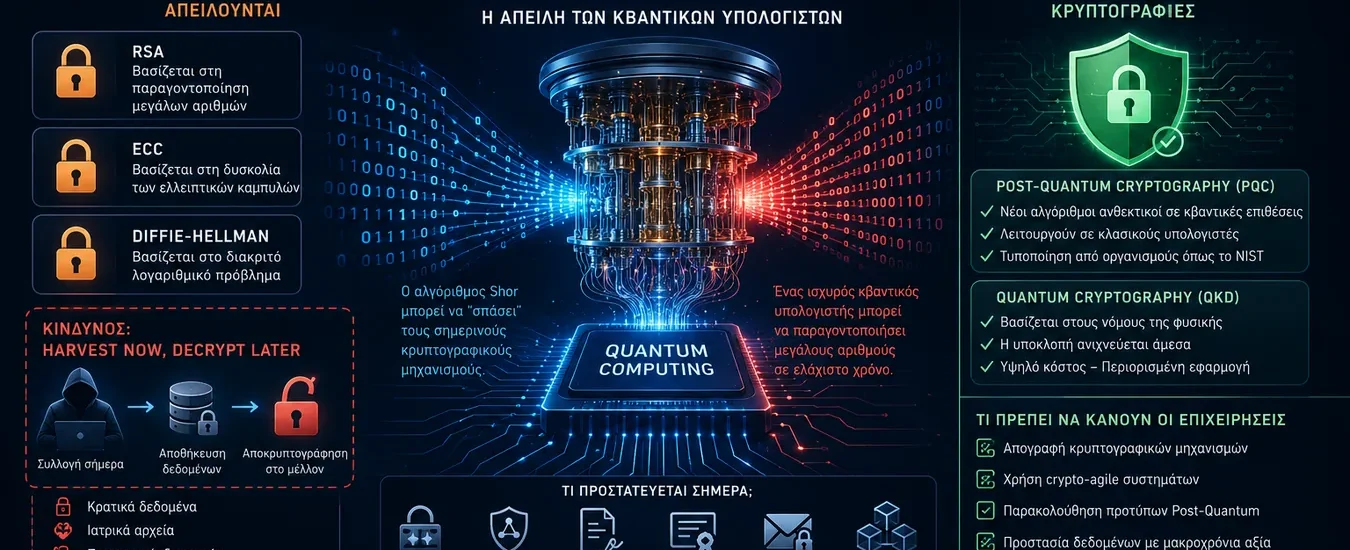
Most modern encryption mechanisms rely on the difficulty of solving specific mathematical problems using classical computers.
Examples include:
- RSA
- ECC (Elliptic Curve Cryptography)
- Diffie-Hellman
However, a sufficiently powerful quantum computer could theoretically “break” these mechanisms using Shor's algorithm.
N = p \times q
This algorithm enables the rapid factorization of large integers — a capability that directly threatens the foundation of RSA cryptosystem encryption.
This means that, in the future, the following could be affected:
- HTTPS
- VPNs
- SSL/TLS certificates
- digital signatures
- encrypted emails
- blockchain technologies
Harvest Now, Decrypt Later
One of the greatest risks is not limited to the future — it already concerns the present.
The “Harvest Now, Decrypt Later” scenario describes a strategy in which attackers:
- collect encrypted data today
- store them for future use
- and decrypt them in the future once quantum technology becomes sufficiently advanced.
This is particularly critical for long-term sensitive data, such as:
- government data
- medical records
- financial information
- intellectual property
- classified communications
The threat primarily concerns the long-term confidentiality of sensitive data.
What Is Post-Quantum Cryptography (PQC)?
The cybersecurity community’s response to this challenge is Post-Quantum Cryptography (PQC).
PQC focuses on developing new cryptographic algorithms that:
- operate on classical computers
- remain resistant to both classical and quantum attacks
Organizations such as the National Institute of Standards and Technology (NIST) are already working on standardizing post-quantum cryptographic standards that will gradually replace today’s cryptographic systems.
Quantum Cryptography vs Post-Quantum Cryptography
It is important to distinguish between two different concepts.
1. Post-Quantum Cryptography
PQC is based on:
- new mathematical algorithms
- quantum-resistant encryption schemes
- the ability to integrate into existing infrastructures
Today, it represents the most realistic solution for businesses and organizations.
2. Quantum Cryptography (QKD)
Quantum Cryptography relies on the physical laws of quantum mechanics.
The most well-known example is:
- Quantum Key Distribution (QKD)
In these systems:
- any interception attempt is immediately detectable
- security is based on the laws of physics rather than solely on mathematics
However:
- the cost remains high
- the required infrastructure remains limited
- and practical implementation is still at an early stage.
When Will It Realistically Affect Us?
Quantum computers capable of “breaking” modern encryption technologies are not yet available at a practical scale.
Nevertheless
- the transition to new cryptographic standards will require many years
- today’s sensitive data may remain valuable for decades
- governments and organizations are already beginning to develop transition strategies
Preparation cannot begin at the last minute.
What Businesses Should Start Doing Today
Although the quantum threat may still seem distant, there are practical steps that organizations can start taking today.
Key actions include:
- crypto inventory and mapping of cryptographic assets
- adopting crypto-agile systems
- monitoring NIST post-quantum cryptography standards
- protecting long-term sensitive data
- developing a strategic migration plan
- assessing third-party cryptographic dependencies
Organizations that prepare early will be able to adapt more smoothly to the emerging cryptographic landscape.
Conclusion
Quantum computing is no longer science fiction. It is a rapidly evolving technology with the potential to fundamentally reshape the future of cybersecurity.
Traditional forms of encryption are not expected to “collapse” overnight, but the future will require:
- strategic thinking
- preparation
- awareness
- and a gradual transition toward quantum-safe technologies
Quantum security is not a luxury or a theoretical concept. It represents the next essential step in the evolution of digital security.
Find more Cyber Security articles or contact us to learn how to better protect yourself, your business, and your digital environment from modern cyber threats.