Phishing has always been a numbers game. Send 1,000 emails with poor grammar, maybe 50 people fall for it. But now, artificial intelligence is changing everything. Attackers no longer need crude tactics. They have ChatGPT writing perfect emails, AI cloning CEOs’ voices, and deepfakes making video calls indistinguishable from reality.
Welcome to the future of AI phishing—a threat that’s not coming, it’s already here.
What is AI Phishing?
AI phishing isn’t your grandfather’s mass email campaign. It’s targeted, personalized, and devastatingly effective.
Traditional phishing works through volume and obvious errors:
- Generic greeting (“Dear Customer”)
- Grammar mistakes
- Generic urgent requests
- Obvious spoofed domain
AI phishing eliminates every red flag:
- Uses LinkedIn research to personalize messages
- Perfect grammar and natural tone
- Contextual details about the target
- Mimics company culture and style
- Timing aligns with business calendars
Real example (2024): A Google employee received a phishing email claiming to be from Google’s payroll department about a “tax compliance issue.” The email was so personalized—referencing specific projects, using internal terminology, matching the exact tone of real HR emails—that the employee almost gave up their credentials. Only a verification call caught it.
This is AI phishing in action.
The 4 Most Dangerous AI-Powered Attack Methods
1. Generative AI Email Phishing
ChatGPT and similar models allow attackers to generate hundreds of perfectly written phishing emails tailored to individual targets in seconds.
How it works:
- Attacker researches target on LinkedIn
- Uses AI to write contextual phishing email
- Email mentions specific projects, names, recent company news
- Perfect grammar and tone matching the target’s work environment
- Victim can’t tell it’s not legitimate
Detection challenge: Even spam filters struggle because there’s nothing technically “wrong” with the email.
Defense: Verify requests through out-of-band communication (call the number from your company phone list, not from the email).
2. Voice Cloning & Deepfake Calls
AI can now clone someone’s voice with remarkable accuracy from just a few seconds of audio. Attackers use this to:
- Impersonate executives requesting urgent wire transfers
- Clone your boss’s voice for credential verification
- Create convincing audio evidence of false statements
Real case (2024): A finance director received a call from someone claiming to be the CEO. The voice was identical—because it was AI cloned from a recorded earnings call. The “CEO” requested an urgent $243,000 wire transfer. The director complied. Only later did they discover it was fraud.
Why this works: We trust voices. A voice call feels personal and authentic in a way email doesn’t. Add AI cloning to that psychology, and verification becomes nearly impossible.
Defense: Establish a code word for urgent requests. No executive should bypass verification for urgent transfers.
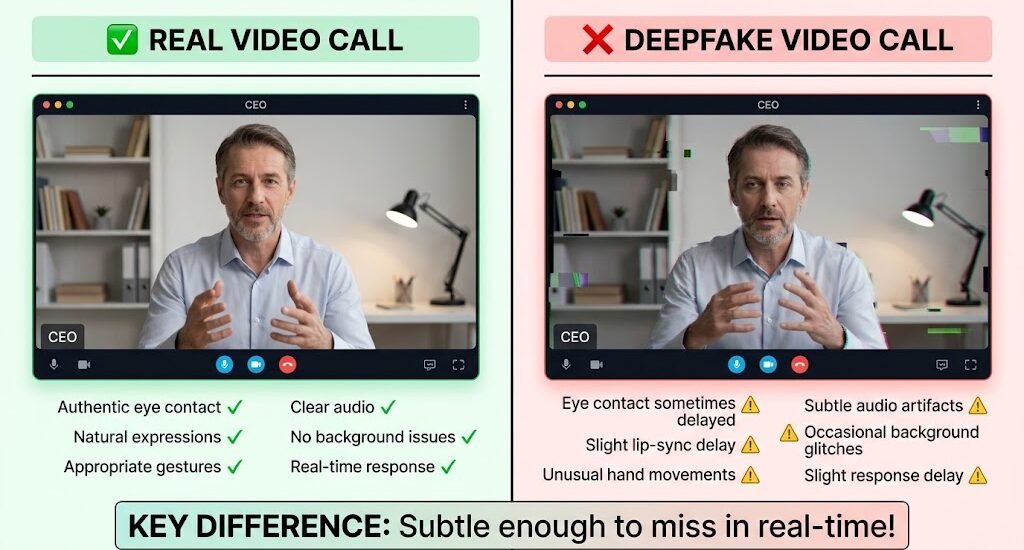
3. Deepfake Video Calls
AI video generation can create convincing video calls where someone impersonates another person in real-time. An attacker can:
- Join a video conference as a senior executive
- Initiate a “private” video call to discuss sensitive matters
- Manipulate victims into revealing credentials or approving transactions
Challenge: Most people can’t distinguish deepfake video from reality.
Defense: Video calls should require multi-factor authentication and be scheduled through verified channels, never spontaneous.
4. SMS & Social Media AI Impersonation
AI-generated messages on SMS, WhatsApp, and social media can impersonate trusted contacts with perfect tone matching. An attacker can:
- Send SMS from someone claiming to be your bank
- Message from “dad” asking for emergency wire transfer
- Impersonate customer support with perfect terminology
Defense: Official companies never request sensitive info via SMS. Verify through official channels.
The Statistics: Why AI Phishing is a Crisis
- 70% of phishing attacks now use AI to some degree (up from 5% in 2022)
- Deepfake audio/video fraud increased 8x in 2024 compared to 2023
- $343 million lost to AI-powered fraud in 2024 alone
- Average response time: 6 seconds from receiving phishing email to clicking malicious link
- AI-written phishing emails have 35% higher success rate than human-written equivalents
The problem accelerates: As AI improves, attackers don’t need sophistication—they just need ChatGPT.
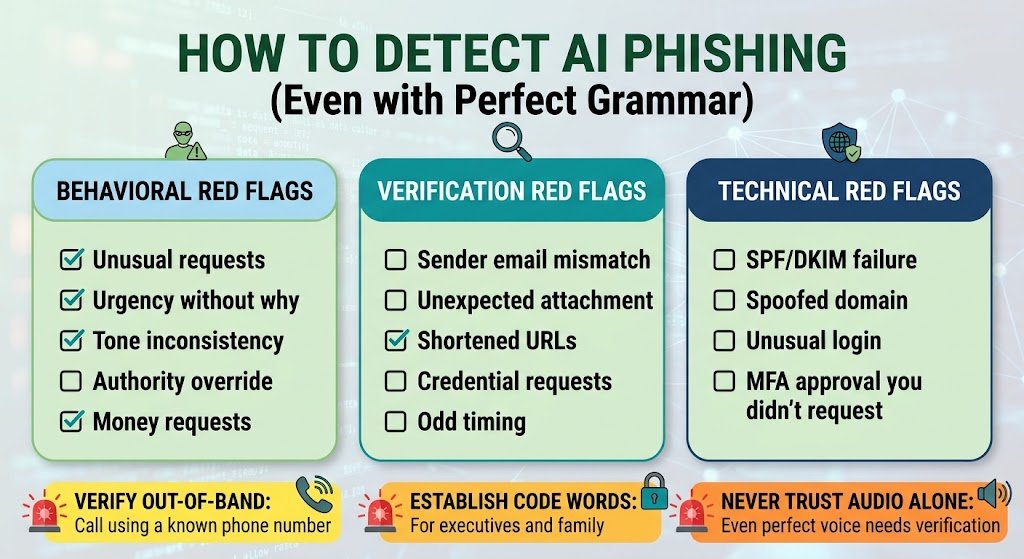
How to Detect AI Phishing (When Grammar is Perfect)
Traditional phishing detection relied on poor grammar. AI phishing removes that crutch. Here’s what to watch for instead:
Behavioral Red Flags
Unusual requests: Even perfectly written emails requesting sensitive data are suspicious Urgency without context: “Act immediately” without explaining why Tone inconsistency: Writing style doesn’t match the sender’s typical communication Mismatched authority: Someone who never requests money suddenly needs a wire transfer
Verification Red Flags
Sender email mismatch: Address looks slightly off (similar domain, slight variation) Unexpected attachment: Even from “trusted” senders Shortened/suspicious links: Click with caution Requests to verify credentials: Real companies never ask this via email
Technical Red Flags
- SPF/DKIM failures: Email authentication shows spoofing (use email headers to check)
- Anomalous login patterns: Your account shows login from unusual location
- New MFA device approval: You didn’t request approval from a new device
Key principle: When in doubt, verify out-of-band. Call using a phone number you know is legitimate. Don’t use contact info from the suspicious email.
Real-World AI Phishing Cases (2024-2025)
Case 1: The Google Engineer
A Google employee received an email from “Google HR” about a tax compliance issue. The email:
- Referenced specific recent projects
- Used internal Google terminology
- Matched the exact format of real HR emails
- Came from a spoofed but similar domain
- Was so convincing the employee almost entered credentials
What saved them: A security presentation they’d attended that week about AI phishing. They called HR to verify using a known number. HR confirmed it was fraud.
Lesson: Training on emerging threats works.
Case 2: The CEO Impersonation
A finance director received a call from someone claiming to be the CEO. The voice was perfect—inflection, accent, speech patterns all matched. The “CEO” needed a $243,000 wire transfer urgently for an acquisition.
The director complied. Only the next day did the real CEO ask about the wire transfer.
What made it work:
- Voice cloning from publicly available earnings call recordings
- Psychological manipulation (CEO authority + urgency)
- The director had no verification protocol for voice calls
Lesson: Voice authentication needs additional verification steps, even for executives.
Case 3: The WhatsApp Scam
A woman received a message from her “son” on WhatsApp: “Mom, my phone broke. Can you send me $500 via wire transfer? I’ll pay you back.”
The message perfectly matched her son’s writing style and tone. She almost sent the money before calling him directly.
What made it convincing:
- AI analysis of previous messages to match tone
- SMS/WhatsApp impersonation
- Psychological manipulation (parent/child urgency)
Lesson: Unexpected requests for money should always be verified by calling, not texting.
Defense Strategies Against AI Phishing
1. Multi-Layer Verification
Never rely on a single authentication method. For sensitive requests:
- Email request → Verify via phone call
- Phone call → Verify via video call or in-person
- Video call → Use code words or secondary verification
- Urgent transfer → Require dual approval from different people
2. Employee Training (Updated)
Traditional phishing training focused on grammar and obvious red flags. AI phishing training must focus on:
- Verification protocols for all requests
- Authority manipulation tactics
- Psychological urgency tactics
- Establishing code words for sensitive requests
- Out-of-band verification procedures
3. Organizational Controls
Wire transfer limits: No single person can approve transfers over certain amounts Dual authorization: Two approvers required for large transactions Voice verification codes: Executives use pre-established codes for urgent requests Email authentication: Implement DMARC/DKIM to detect spoofing Behavioral analytics: Flag unusual transaction patterns
4. Technical Defenses
Advanced email filtering: AI-powered systems that detect contextual phishing MFA on all accounts: Especially email and financial systems Hardware security keys: For executive/finance accounts Endpoint detection: Monitor for unusual activity patterns SMS filtering: Block spoofed SMS from “banks” or “services”
5. Personal Practices
Verify independently: Never use contact info from the suspicious message Establish code words: For family/business urgency situations Use separate channels: Important requests should come through multiple channels Screenshot nothing: Photos of conversations can be deepfaked Think before clicking: AI phishing removed grammar as a red flag—make skepticism your default
The Future: What’s Coming Next
2025 threats to expect:
- Real-time voice cloning: AI that can clone voices mid-conversation
- Deepfake video at scale: High-quality deepfake videos accessible to non-experts
- Multimodal attacks: AI phishing combining email + voice + video + SMS
- AI-optimized social engineering: Psychology combined with AI personalization
- Supply chain AI attacks: Compromising vendors to reach large customer bases
The defense becomes simpler but more critical: Trust nothing without independent verification.
FAQ: AI Phishing Questions
Q: If my boss calls me, how do I verify it’s really them?
A: Ask them a question only they would know the answer to. Use a pre-established code word. Or call them back using a number from your company directory (not from the incoming call).
Q: Can AI phishing bypass MFA?
A: No, but attackers can phish your MFA code. Don’t share MFA codes even if someone claims to be support. Legitimate companies never request MFA codes.
Q: Is my company vulnerable to AI phishing?
A: Yes. Every company with employees who send emails or make phone calls is vulnerable. The question is how prepared your defenses are.
Q: Should I be paranoid about every email?
A: No, but skeptical yes. Verify sensitive requests. Don’t click links you weren’t expecting. Call to confirm unexpected asks for money or credentials.
Q: Can I detect deepfake audio?
A: Sometimes, but not reliably. Deepfake technology improves constantly. Behavioral verification (code words, callback verification) is more reliable than audio analysis.
Conclusion: Adapt or Risk
AI phishing isn’t a future threat. It’s operational right now. In 2024, organizations lost hundreds of millions to AI-powered fraud. In 2025, that number will be larger.
The good news: Defense is possible. It requires training, processes, and psychological awareness rather than advanced technology.
The shift is simple but profound:
Old model: Phishing worked because attackers made obvious mistakes.
New model: Phishing works because verification is inconvenient.
The solution isn’t better email filters. It’s better people—people who verify before they comply, regardless of how perfect the email or how convincing the voice.
External links for more information:
NIST – AI Security & Risk Management
CISA – Phishing & Deepfake Defense
FBI IC3 – Phishing & Deepfakes
Find more Cyber Security articles or contact us to learn how to better protect yourself, your business, and your digital environment from modern cyber threats. Also, explore How attackers bypass MFA to commit CEO fraud
This article is published exclusively for informational and educational purposes. Its goal is to enhance cybersecurity awareness, inform users, and help prevent modern digital threats.The information presented is not intended for malicious use or to promote illegal activities.