In cybersecurity, technical knowledge is an essential foundation — but on its own, it is not enough. Many professionals understand tools, exploits, and penetration testing methodologies, yet fail to grasp the most critical element of a real-world attack: the attacker’s mindset.
The offensive mindset is not about specific tools or techniques. It is about the mentality behind every decision made throughout the lifecycle of an attack.
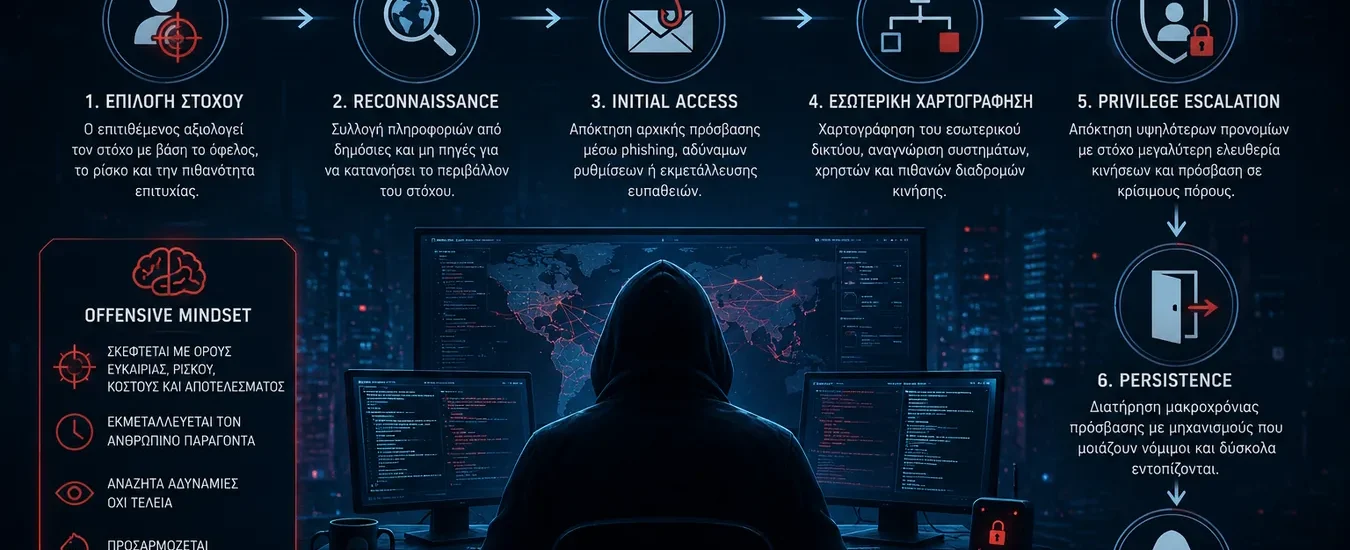
A real threat actor does not follow manuals or think in purely theoretical vulnerability categories. Instead, attackers think in terms of:
- opportunity
- risk
- cost
- and outcome
Understanding this way of thinking is critical for both offensive and defensive security teams.
Target Selection
An attack does not begin when the first packet is sent or the first exploit is executed.
It begins much earlier — during target selection.
An attacker evaluates:
- whether an organization is worth the time and risk
- how mature its security posture is
- the probability of success
- and the potential reward
Factors such as:
- industry sector
- public exposure
- technological maturity
- cloud infrastructure
- and overall attack surface
play a major role.
In practice, many organizations become targets not because they possess something unique, but because they appear easy to compromise.
A poorly configured web portal, exposed services, or leaked internal information can effectively serve as an invitation to attack.
For the attacker, an operation is an investment of time and resources — not an end goal in itself.
Reconnaissance – Thinking Before Acting
Within the offensive mindset, reconnaissance is not merely information gathering. It is the process of understanding the target environment.
Attackers seek to identify:
- the weakest points
- the most valuable users
- critical systems
- and potential access paths
In real-world scenarios, many attacks rely entirely on publicly available information.
Examples include:
- job postings revealing technologies in use
- social media posts exposing internal structures
- forgotten subdomains
- exposed cloud assets
- unsupported legacy applications
Attackers are rarely in a hurry. Every piece of information reduces the need for noisy actions later.
Initial Access – Entry Does Not Need to Be Sophisticated
Initial access is rarely achieved through “cinematic” techniques.
In reality, most compromises rely on:
- human error
- weak passwords
- misconfigurations
- or exposed services
A phishing email or an incorrectly configured cloud environment may be enough for an initial compromise.
From the attacker’s perspective, the goal is not an impressive entry point, but functional access.
Even limited privileges are often sufficient to begin internal reconnaissance and environmental mapping.
Patience frequently outweighs speed.
Internal Mapping and Adaptation
Once initial access is achieved, the attacker’s mindset evolves.
The focus shifts from vulnerabilities alone to:
- opportunities
- relationships between systems
- high-value accounts
- weak operational processes
- and possible lateral movement paths
Adaptability is a core element of the offensive mindset.
If a system proves more secure than expected, attackers rarely insist on forcing access. Instead, they search for alternative, less obvious paths.
Privilege Escalation – From Useful to Critical
Privilege escalation is not viewed as a technical objective, but as a strategic tool.
An attacker evaluates:
- what level of access is truly necessary
- which level provides greater operational freedom
- and which level increases detection risk
In many environments, domain-level access does not require advanced exploits, but rather:
- poor privilege management
- credential exposure
- weak administrative practices
- or organizational weaknesses
Sometimes, maintaining lower privileges is safer than attempting aggressive privilege escalation that could trigger detection mechanisms.
Persistence – The Attack as a Marathon
For a real attacker, success is not measured solely by gaining initial access, but by maintaining it.
Persistence is a fundamental component of any serious intrusion.
Attackers often create:
- new user accounts
- scheduled tasks
- hidden access mechanisms
- policy modifications
- persistence through legitimate-looking configurations
in ways that blend naturally into the organization’s normal operations.
In many cases, the intrusion becomes an “invisible” part of the daily environment.
Evasion and Risk Management
Contrary to popular perception, most attackers are not seeking immediate chaos or destruction.
In many cases, their priorities are:
- avoiding detection
- maintaining long-term access
- and minimizing exposure risk
Every action is evaluated based on:
- operational value
- detection risk
- and whether the action is truly worth performing
This explains why many compromises remain undetected for months — or even years.
The absence of noise does not mean the absence of malicious activity. In many cases, it reflects a high level of restraint and discipline.
What the Offensive Mindset Reveals About Defense
Understanding the offensive mindset fundamentally changes how defense should be designed.
Rather than relying on fragmented security measures, it highlights the need for:
- comprehensive visibility
- strong identity management strategies
- behavioral monitoring
- insufficient network segmentation
- and continuous risk assessment
Organizations that think defensively with an offensive perspective can anticipate not only how an attack may occur, but also why.
Conclusion
The offensive mindset is not learned through tools or checklists.
It is developed through:
- understanding real-world attacks
- exposure to realistic scenarios
- strategic thinking
- and continuous engagement with adversarial behavior
For professionals involved in:
- Ethical Hacking,
- Penetration Testing
- Red Teaming
- Blue Teaming
- Threat Hunting
understanding the attacker’s mindset is a critical stage of professional maturity.
Real cybersecurity is not only about technology. It is about understanding the human being behind the attack.
Find more Cyber Security articles or contact us to learn how to better protect yourself, your business, and your digital environment from modern cyber threats.