Penetration Testing Methodology – From Reconnaissance to Reporting
A penetration test is not a random attempt to “break something,” nor a chaotic use of security tools. It is a structured process that follows specific stages, aiming not only to identify vulnerabilities but also to understand the real risk they pose to an organization.
Methodology is what differentiates a professional security assessment from a superficial technical test. From information gathering to the final report, every phase plays a critical role in evaluating the overall attack surface.
In this article, we will follow the natural flow of a penetration test, examining realistic scenarios that reflect how real-world attackers operate.
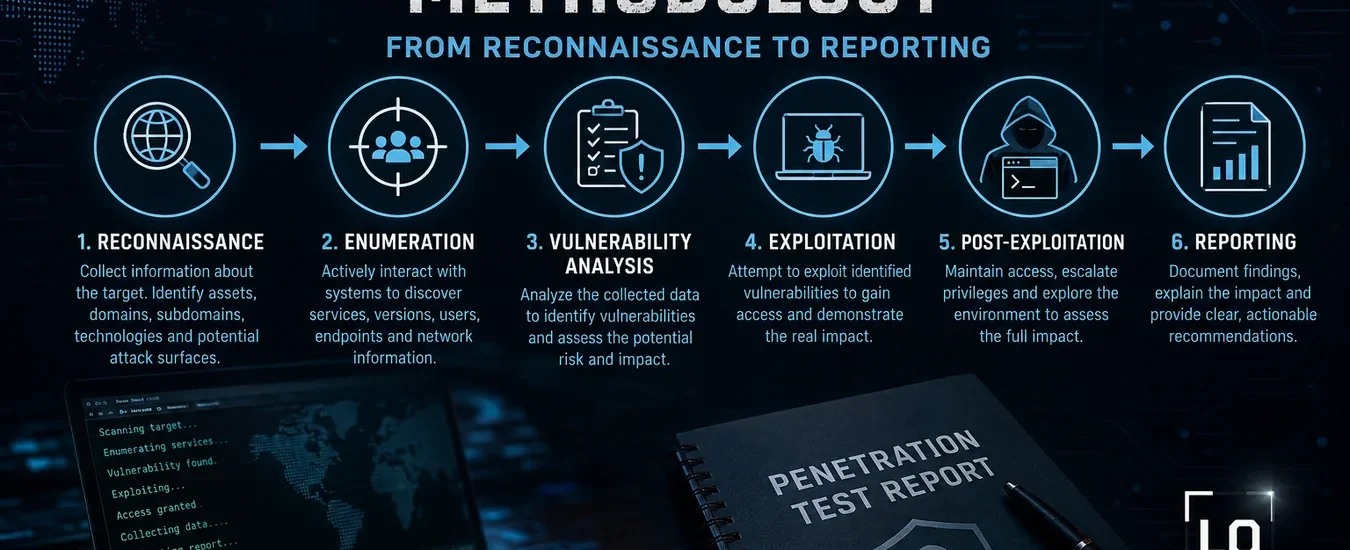
Reconnaissance – The Value of Information
The reconnaissance phase forms the foundation of every successful penetration test. At this stage, the tester gathers as much information as possible about the target without necessarily interacting directly with its systems.
This information may include:
- domains και subdomains
- IP ranges
- cloud infrastructures
- technologies and services
- email formats
- publicly available organizational information
In real-world attacks, threat actors spend significant time on reconnaissance because many critical weaknesses are not found in exploits, but in improperly exposed information.
A common example is the discovery of forgotten test environments or legacy applications that remain accessible from the internet without adequate protection.
In one real-world penetration test, a simple DNS record analysis led to the discovery of a test environment using default credentials. The compromise did not require advanced techniques, but rather careful observation and proper information analysis.
Enumeration – When the Picture Becomes Clear
Once the initial information gathering is completed, the enumeration phase follows. At this stage, the tester actively interacts with the target systems to identify:
- services
- software versions
- API endpoints
- authentication mechanisms
- network exposure
Enumeration is often the point where general information transforms into realistic attack opportunities.
Identifying an outdated web server version or an endpoint lacking proper access control can shape the entire testing strategy.
In corporate environments, internal penetration tests frequently uncover internal services that are absent from official documentation. Lack of visibility alone represents a significant security risk.
Vulnerability Analysis – From Information to Risk
At this stage, the collected data is analyzed in order to identify actual weaknesses.
Vulnerability analysis is not limited to automated scanning tools. It requires experience, judgment, and an understanding of how seemingly minor weaknesses can be chained together into attack paths.
In many cases, a low-severity vulnerability may become a critical component for privilege escalation or lateral movement.
A common example involves the combination of:
- misconfigurations
- weak access control
- excessive user permissions
which ultimately leads to full system compromise.
Exploitation – Proving the Impact
The exploitation phase is what fundamentally distinguishes penetration testing from a simple vulnerability assessment.
At this stage, the tester demonstrates that a vulnerability can actually be exploited.
The objective is not destruction or operational disruption, but the controlled validation of real-world risk.
In production environments, exploitation is conducted with extreme caution, usually through:
- limited data retrieval
- proof-of-concept access
- non-destructive commands
A common real-world scenario involves exploiting a weak authentication mechanism that provides initial access as a low-privileged user. From there, poor privilege management may allow the tester to perform privilege escalation and gain access to critical systems.
Post-Exploitation – What an Attacker Can Do Next
Successfully exploiting a vulnerability does not mark the end of an attack.
During the post-exploitation phase, the tester evaluates:
- lateral movement possibilities
- credential exposure
- access persistence
- access to sensitive information
- potential full environment compromise
In many cases, a compromised workstation is simply the initial entry point that may eventually lead to domain compromise or access to critical infrastructure.
These scenarios help organizations understand how an apparently minor breach can evolve into a serious security incident.
Reporting – The Most Critical Phase
Although often underestimated, reporting is arguably the most important stage of a penetration test.
A poor report can dramatically reduce the value of all the technical work that preceded it.
The purpose of a penetration testing report is not to impress technically, but to:
- clearly communicate the risk
- explain the potential impact
- effectively guide decision-making
A high-quality report tells the complete “story” of the attack:
- how it started
- which steps were followed
- what level of access was achieved
- what the real-world consequences were
At the same time, it must provide realistic and actionable remediation recommendations tailored to the organization’s environment.
Conclusion
Penetration testing methodology is not simply a sequence of technical steps, but a complete mindset focused on risk evaluation and security assessment.
From reconnaissance to reporting, every stage contributes to building a comprehensive understanding of the attack surface and the actual threats facing an organization.
The real value of a penetration test does not lie solely in the number of vulnerabilities identified, but in how well the organization understands the ways in which it could realistically be attacked.
In future articles, we will explore individual offensive security techniques and more advanced web application attack scenarios in greater depth.
Find more Cyber Security articles or contact us to learn how to better protect yourself, your business, and your digital environment from modern cyber threats.